
- Home
- Company
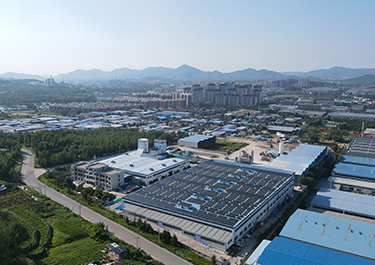 Our FactoryWe have a team of more than 30 talented geotechnical material R&D experts and a 30,000 square meter advanced modern intelligent manufacturing plant.
 - Products
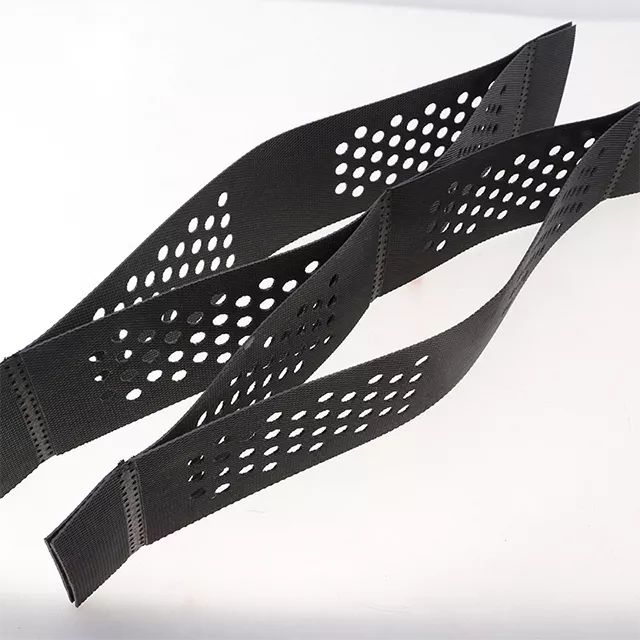 Geocell is a three-dimensional mesh structure made of high-strength polymer sheets (such as HDPE, PP, etc.) through ultrasonic welding. When unfolded, it presents a three-dimensional grid shape.
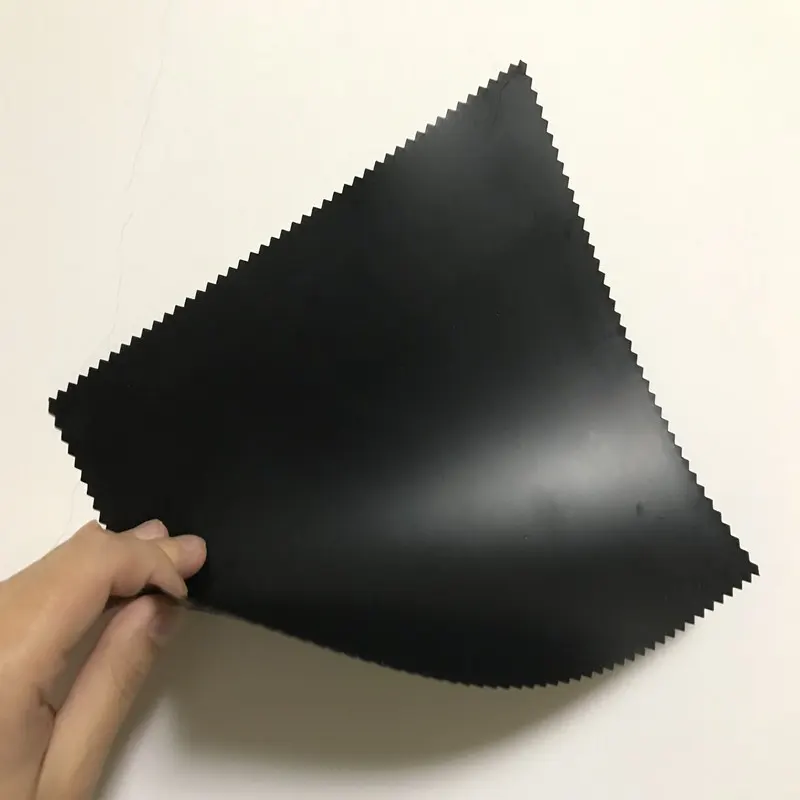 Geomembrane is a thin, extremely low-permeability sheet material made from high-molecular-weight polymers (high-density polyethylene, linear low-density polyethylene).
 - Blog
- Contacts
Woven vs Nonwoven Geotextile: Top 7 Project Selection Tips


Geotextiles are among the most versatile geosynthetic materials in civil engineering. They separate, filter, drain, reinforce, and protect—often performing multiple functions simultaneously. But here's the challenge: woven geotextile and nonwoven geotextile are fundamentally different materials, and choosing the wrong one can lead to clogged drainage systems, inadequate reinforcement, or premature project failure.
Unlike geomembranes—which are primarily impermeable barriers—geotextiles are permeable fabrics engineered for specific mechanical and hydraulic functions. The distinction between woven geotextile and nonwoven geotextile is not a matter of quality. It is a matter of matching material properties to project requirements.
This guide provides 7 project selection tips to help engineers, contractors, and procurement professionals choose the right geotextile for their specific application. Each tip includes comparative data, application guidance, and a clear recommendation.
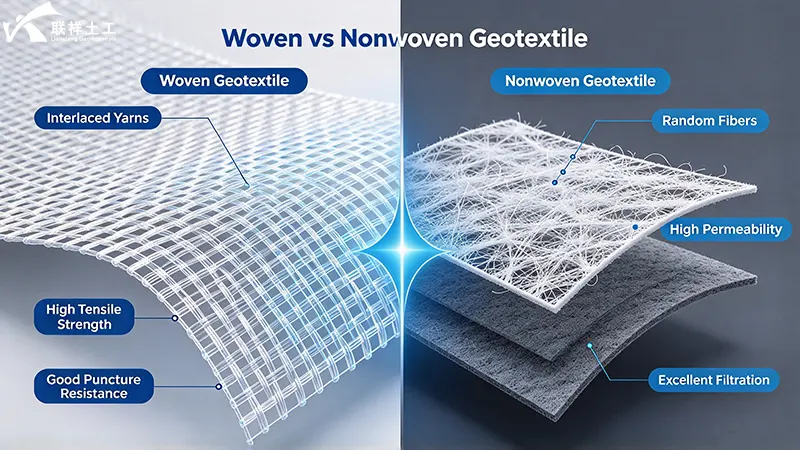
Tip 1: Understand the Manufacturing Difference – Woven vs Nonwoven
The single most important distinction between woven geotextile and nonwoven geotextile is how they are manufactured—and how that manufacturing process determines their performance characteristics.
Woven geotextile is manufactured by weaving yarns (typically polypropylene or polyester) together on a loom, similar to how clothing fabric is produced. This creates a regular, grid-like structure with high tensile strength and low elongation.
Nonwoven geotextile is manufactured by bonding synthetic fibers together through mechanical needling, thermal bonding, or chemical adhesion. This creates a random, felt-like structure with excellent permeability, filtration capability, and flexibility.
| Property | Woven Geotextile | Nonwoven Geotextile |
| Manufacturing | Weaving yarns on a loom | Needling, thermal, or chemical bonding |
| Structure | Regular grid (like canvas) | Random felt-like (like felt) |
| Tensile strength | High | Moderate |
| Elongation | Low (10–25%) | High (50–80%) |
| Permeability | Moderate–low | High |
| Filtration | Limited | Excellent |
| Flexibility | Low | High |
| Puncture resistance | Moderate | Good |
Key takeaway: A woven geotextile is a high-strength, low-elongation material. A nonwoven geotextile is a high-permeability, high-flexibility material. These fundamental differences drive every application decision that follows.
Tip 2: Compare Tensile Strength & Elongation
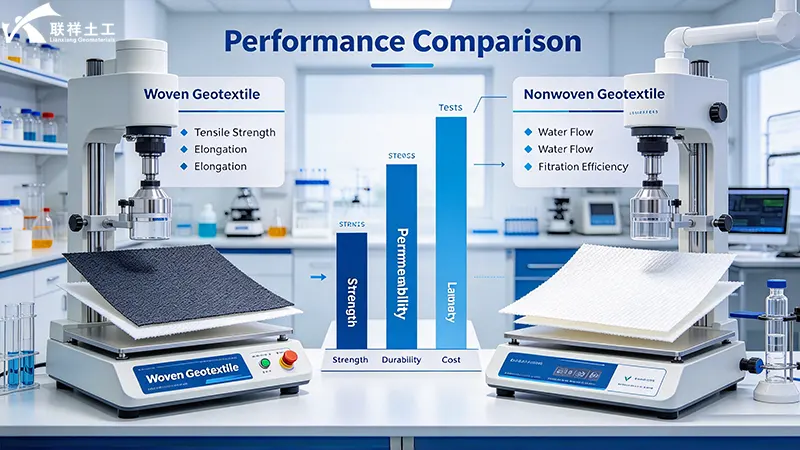
Tensile strength is the primary performance parameter for reinforcement and separation applications—and it is where woven geotextile and nonwoven geotextile diverge most dramatically.
Woven geotextile tensile performance:
- High tensile strength—typically 50–200 kN/m depending on yarn type and weave density
- Low elongation at break—typically 10–25%
- High modulus—mobilizes tensile resistance at low strain
Nonwoven geotextile tensile performance:
- Moderate tensile strength—typically 10–50 kN/m
- High elongation at break—typically 50–80%
- Low modulus—requires significant strain to mobilize tensile resistance
| Parameter | Woven Geotextile | Nonwoven Geotextile |
| Tensile strength (typical) | 50–200 kN/m | 10–50 kN/m |
| Elongation at break | 10–25% | 50–80% |
| Modulus | High | Low |
| Primary function | Reinforcement, separation | Filtration, drainage, protection |
Why this matters for project selection: If your project requires soil reinforcement—such as unpaved roads, working platforms, or steep slopes—a woven geotextile is the appropriate choice. Its high tensile strength and low elongation allow it to carry loads and distribute them across a wider area. If your project requires filtration or drainage, a nonwoven geotextile is generally the better fit.
Tip 3: Evaluate Permeability & Filtration Performance
Permeability—the ability of water to flow through the fabric—is the defining hydraulic property of any geotextile. And it is here that nonwoven geotextile outperforms woven geotextile in most applications.
Woven geotextile permeability: The tight weave of a woven geotextile limits cross-plane permeability. While water can pass through the grid openings, the flow capacity is generally lower than that of a nonwoven fabric. Woven geotextiles are rarely used as primary drainage or filtration layers.
Nonwoven geotextile permeability: The random fiber network of a nonwoven geotextile creates a three-dimensional pore structure with high cross-plane permeability. This allows water to flow freely while retaining fine soil particles—exactly what filtration and drainage applications demand.
| Parameter | Woven Geotextile | Nonwoven Geotextile |
| Cross-plane permeability | Moderate–low | High |
| Pore structure | Uniform grid openings | Random 3D fiber network |
| Soil retention | Limited | Excellent |
| Clogging resistance | Moderate | Good |
| Primary use | Separation, reinforcement | Filtration, drainage |
Performance data: For filtration applications, the nonwoven geotextile must balance two competing requirements: it must retain soil particles (preventing piping and erosion) while allowing water to pass through (preventing clogging and pressure buildup). The random fiber structure of nonwoven fabrics is specifically engineered to achieve this balance—something a woven geotextile cannot match.
Key takeaway: For drainage and filtration applications—retaining walls, French drains, underdrains, and subsurface drainage systems—a nonwoven geotextile is the clear choice. For separation and reinforcement, a woven geotextile is preferred.
Tip 4: Assess Separation & Reinforcement Capability
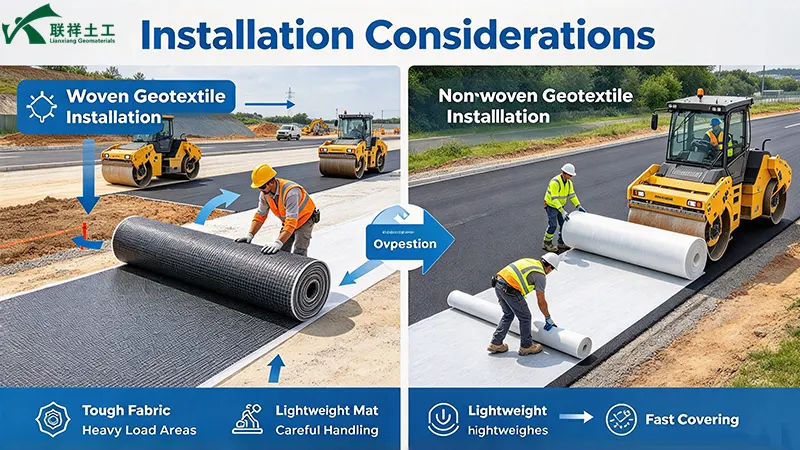
Separation and reinforcement are two of the most common functions of any geotextile—and the choice between woven geotextile and nonwoven geotextile is critical to performance.
Separation: In road construction and earthworks, different soil layers must remain distinct to prevent intermixing. Without separation, aggregate can sink into soft subgrade, leading to loss of bearing capacity and premature pavement failure.
- Woven geotextile is the preferred choice for separation under heavy loads. Its high tensile strength and low elongation allow it to stabilize granular layers over soft soils, acting as a barrier that prevents aggregate from punching into the subgrade.
- Nonwoven geotextile can also be used for separation, but it is generally less effective under heavy loads due to its lower tensile strength. It may be suitable for light-duty separation where filtration is also required.
Reinforcement: When subgrade soils lack sufficient bearing capacity, reinforcement geotextiles provide tensile strength to distribute loads and limit deformation.
- Woven geotextile is the go-to material for soil reinforcement. Its high tensile strength and low elongation allow it to carry significant loads and distribute them across a wider area. The grid-like structure interlocks with aggregate, creating a mechanically stabilized layer.
- Nonwoven geotextile has limited tensile strength compared to woven fabrics. While it can provide some reinforcement in light-duty applications, it is not suitable for heavy-load reinforcement where high strength is required.
| Function | Woven Geotextile | Nonwoven Geotextile |
| Separation (heavy load) | Excellent | Suitable for light-duty |
| Separation (light load) | Excellent | Good |
| Reinforcement (heavy load) | Excellent | Not suitable |
| Reinforcement (light load) | Good | Limited |
Key takeaway: For separation and reinforcement applications—road base, working platforms, haul roads, and embankment reinforcement—a woven geotextile delivers superior performance. For light-duty separation where filtration is also required, a nonwoven geotextile may be adequate.
Tip 5: Consider Drainage & Protection Applications
Drainage and protection are two application areas where nonwoven geotextile is almost always the material of choice—and where a woven geotextile would be the wrong specification.
Drainage: Water accumulation in soil can destabilize structures, cause frost heave, and reduce bearing capacity. Drainage geotextiles allow water to flow through while preventing soil particles from migrating into drainage systems.
- Nonwoven geotextile excels in drainage applications. Its high permeability and random fiber structure allow water to pass through freely while retaining fine soil particles. It is highly effective in retaining walls, French drains, and subsurface drainage systems.
- Woven geotextile has limited permeability and is rarely used as a primary drainage filter.
Protection: Protection geotextiles are used to shield geomembranes or sensitive surfaces from mechanical damage—punctures, abrasion, or impact from sharp objects.
- Nonwoven geotextile is the preferred choice for protection applications. Its thick, felt-like structure provides excellent cushioning and distributes concentrated loads over a wider area, reducing the risk of punctures. The random fiber network absorbs impact energy and protects underlying geomembranes from abrasion and puncture.
- Woven geotextile has limited protection capabilities due to its thin, flat structure. It does not provide significant cushioning and offers minimal puncture resistance compared to nonwoven fabrics.
| Application | Woven Geotextile | Nonwoven Geotextile |
| Drainage | Poor | Excellent |
| Filtration | Poor | Excellent |
| Protection (geomembrane cushion) | Poor | Excellent |
| Cushioning under riprap | Limited | Excellent |
Key takeaway: For drainage, filtration, and protection applications—retaining walls, French drains, geomembrane protection, and cushion layers—a nonwoven geotextile is the correct specification. Using a woven geotextile in these applications risks clogging, inadequate filtration, and puncture damage.
Tip 6: Analyze Cost-Performance Ratio for Your Project
Cost is always a factor in material selection—but the true cost comparison between a woven geotextile and a nonwoven geotextile goes beyond the unit price per square meter.
Woven geotextile cost profile:
- Generally lower material cost per m² for equivalent tensile strength
- Cost-effective for large-area separation and reinforcement
- Requires less material to achieve a given reinforcement target
Nonwoven geotextile cost profile:
- Higher material cost per m² for equivalent weight
- Cost-effective for filtration, drainage, and protection
- May require thicker grades for equivalent cushioning
| Cost Factor | Woven Geotextile | Nonwoven Geotextile |
| Unit material cost | Lower (for strength) | Higher (for weight) |
| Installation cost | Standard | Standard |
| Performance per dollar | Best for reinforcement | Best for filtration/drainage |
| Lifecycle cost | Low when correctly specified | Low when correctly specified |
The bottom line: The cost-performance ratio depends entirely on the application. A woven geotextile delivers the best value for reinforcement and separation. A nonwoven geotextile delivers the best value for filtration, drainage, and protection. Specifying the wrong type to save money upfront often leads to higher lifecycle costs through repairs, clogging, or premature failure.
Tip 7: Match Geotextile Type to Project Conditions
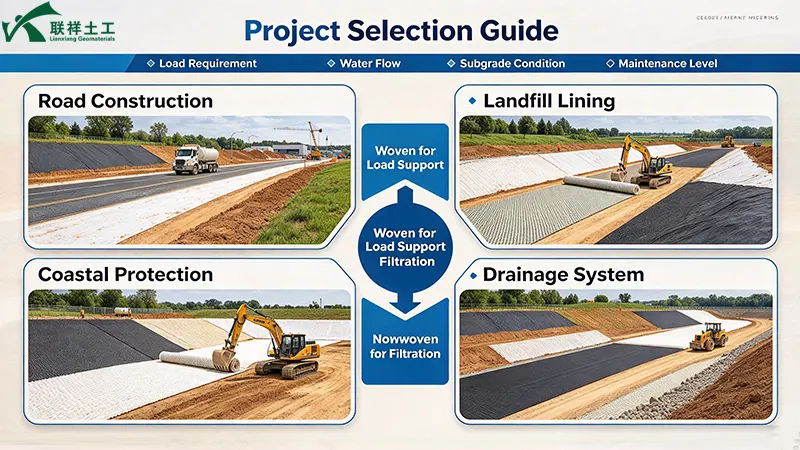
The final—and most practical—selection tip is to match the geotextile type to your specific project conditions. Here is a decision framework based on common civil engineering applications:
| Project Type | Recommended Geotextile | Key Rationale |
| Road base separation | Woven Geotextile | High tensile strength; prevents aggregate punching |
| Unpaved haul roads | Woven Geotextile | Heavy-load reinforcement; load distribution |
| Retaining wall drainage | Nonwoven Geotextile | High permeability; soil retention |
| French drains | Nonwoven Geotextile | Filtration; prevents clogging |
| Geomembrane protection | Nonwoven Geotextile | Cushioning; puncture resistance |
| Slope erosion control | Nonwoven Geotextile | Filtration; soil retention; flexibility |
| Embankment reinforcement | Woven Geotextile | High tensile strength; stability |
| Subsurface drainage | Nonwoven Geotextile | High flow capacity; filtration |
General guidelines for project selection:
- Choose woven geotextile when the primary need is reinforcement or separation under heavy loads—roads, working platforms, haul roads, embankments, and retaining walls.
- Choose nonwoven geotextile when the primary need is filtration, drainage, or protection—retaining wall drains, French drains, geomembrane cushioning, and erosion control.
- In many large projects, both types are used in different layers to achieve optimal performance. For example, a landfill liner system may use a woven geotextile for reinforcement beneath the subgrade and a nonwoven geotextile above the geomembrane for protection and drainage.
Quick Reference: Woven vs Nonwoven Geotextile Selection Guide
| # | Factor | Woven Geotextile | Nonwoven Geotextile |
| 1 | Manufacturing | Woven yarns on loom | Needled/bonded fibers |
| 2 | Tensile & Elongation | High strength, low elongation | Moderate strength, high elongation |
| 3 | Permeability & Filtration | Limited | Excellent |
| 4 | Separation & Reinforcement | Excellent | Light-duty only |
| 5 | Drainage & Protection | Poor | Excellent |
| 6 | Cost-Performance | Best for reinforcement | Best for filtration/drainage |
| 7 | Best Application | Roads, platforms, embankments | Drains, protection, erosion control |
Final Thoughts
Woven geotextile and nonwoven geotextile are not interchangeable. They serve distinct roles in geotechnical engineering, and selecting the right one requires a clear understanding of the project's primary function: reinforcement and separation (woven) or filtration, drainage, and protection (nonwoven).
Remember these core principles:
- Match the material to the function. Don't specify a nonwoven geotextile for heavy-load reinforcement—and don't specify a woven geotextile for drainage.
- Consider the full system. In many projects, both types are used together in different layers to achieve optimal performance.
- Look beyond unit price. The cost-performance ratio depends on correct specification, not on choosing the cheapest option.
- Verify performance data. Request tensile strength, elongation, permeability, and puncture resistance test results for the specific product you are considering.
- Consult with the manufacturer. A reputable geotextile supplier will ask about your project conditions before making a recommendation—not push a single product for every application.
Whether you are building a highway, stabilizing a slope, protecting a geomembrane, or installing a drainage system, the right geotextile selection can mean the difference between a project that performs for decades and one that requires premature repair.
Lianxiang Group supplies both woven and nonwoven geotextiles, along with geomembranes, geocells, and geogrids for civil and environmental projects worldwide. Our technical team can help you select the right geotextile type based on your site conditions, load requirements, and performance goals. Contact us for free samples, technical data sheets, or a customized solution.
Written by
SHANDONG LIANXIANG ENGINEERING MATERIALS CO., LTD.
Kyle Fan
WhatsApp:+86 139 5480 7766
Email:admin@lianxiangcn.com
-
WhatsApp
-
E-MailE-Mail:admin@lianxiangcn.com
-
WeChatWeChat:18554180188