
- Home
- Company
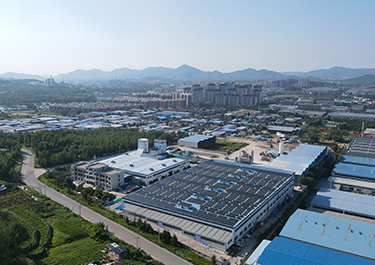 Our FactoryWe have a team of more than 30 talented geotechnical material R&D experts and a 30,000 square meter advanced modern intelligent manufacturing plant.
 - Products
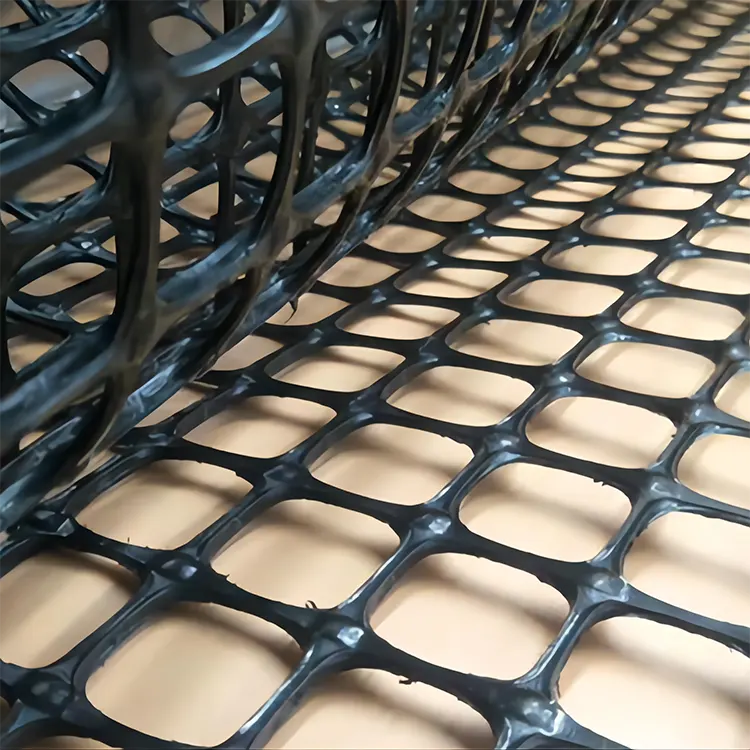
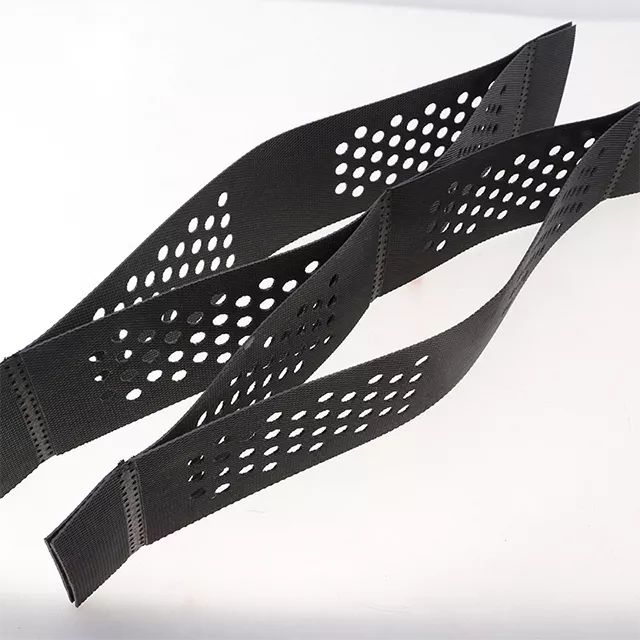 Geocell is a three-dimensional mesh structure made of high-strength polymer sheets (such as HDPE, PP, etc.) through ultrasonic welding. When unfolded, it presents a three-dimensional grid shape.
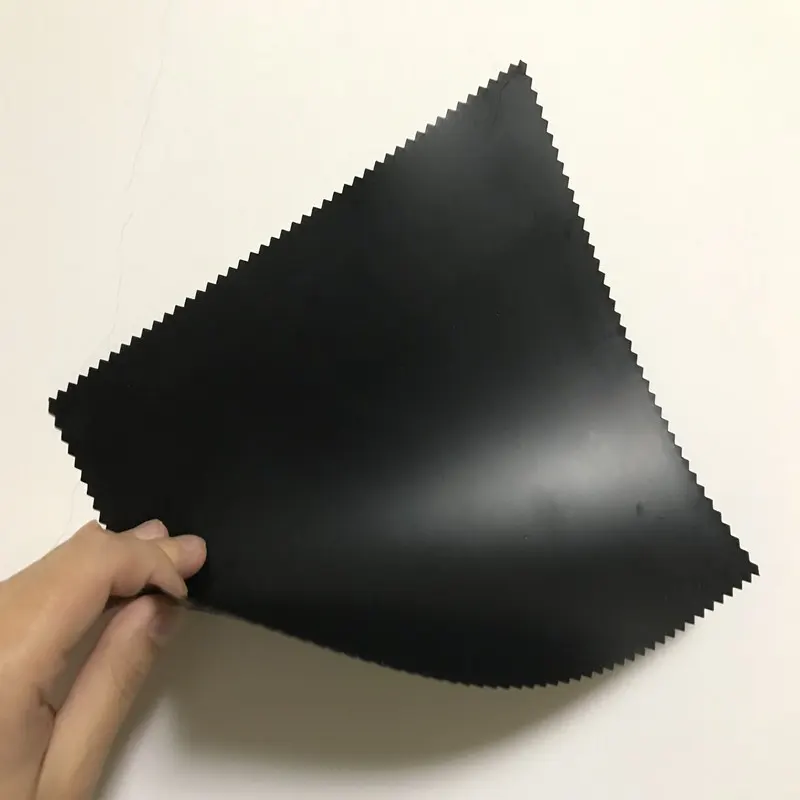 Geomembrane is a thin, extremely low-permeability sheet material made from high-molecular-weight polymers (high-density polyethylene, linear low-density polyethylene).
 - Blog
- Contacts
HDPE Geomembrane Selection: Top 9 Standards & Thickness Guide 2026


Selecting the right HDPE geomembrane isn't just about picking a thickness and hoping for the best. It's about understanding a complex web of international standards, material properties, and application-specific requirements that together determine whether your liner will perform for 20 years or fail in five.
The stakes are high. A poorly specified geomembrane can lead to costly leaks, environmental contamination, regulatory fines, and project delays. Yet many engineers and procurement professionals still rely on outdated specifications or treat all HDPE liners as interchangeable.
This guide cuts through the confusion. Here are the top 9 standards and specifications you need to know for HDPE geomembrane selection in 2026—backed by hard performance data.
Standard 1: GRI-GM13 – The Industry Benchmark
GRI-GM13 is the most widely referenced HDPE geomembrane specification in the world. Published by the Geosynthetic Research Institute (GSI), it is formally titled Test Methods, Test Properties and Testing Frequency for High Density Polyethylene Smooth and Textured Geomembranes.
The current Revision 19, dated June 11, 2025, covers smooth and textured HDPE geomembranes with:
| Parameter | Requirement |
| Formulated sheet density | ≥ 0.940 g/cc |
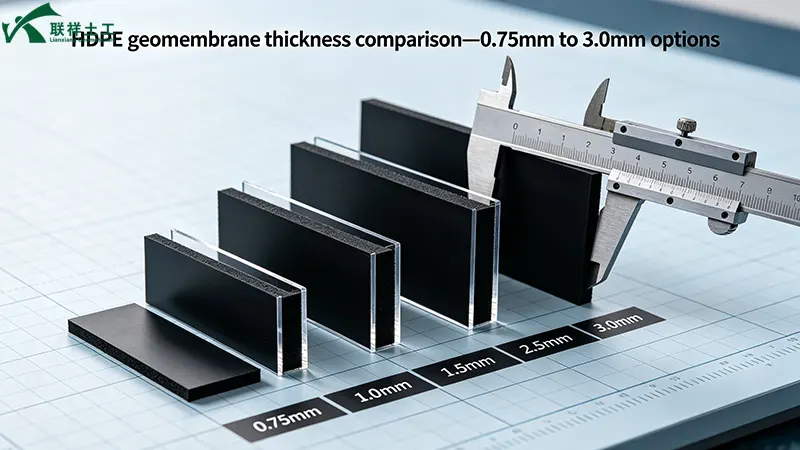
| Nominal thickness range | 0.75 mm to 3.0 mm (30 to 120 mil) |
| Recycled content | Not permitted |
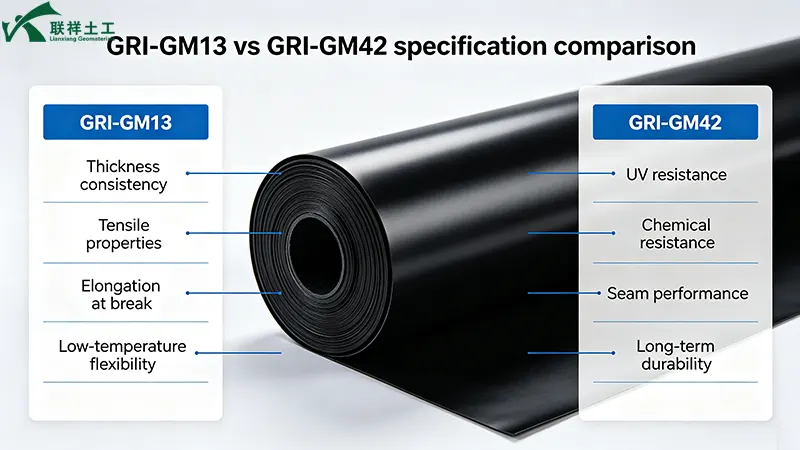
What GRI-GM13 does NOT do: It is primarily a manufacturing quality-control specification. It does not determine the correct thickness for a specific site, required liner-system configuration, chemical compatibility, or guaranteed service life. A project specification may adopt GRI-GM13 and then add more restrictive requirements.
Key takeaway: GRI-GM13 is the minimum baseline—not the final word. Meeting GM13 means the product satisfies manufacturing specifications, but it does not independently prove suitability for every application.
Standard 2: ASTM D5199 – Thickness Measurement
ASTM D5199 is the standard test method for determining the thickness of smooth geomembranes. This is the method referenced by GRI-GM13 for thickness verification.
What you need to know:
- Thickness is measured in millimeters (mm) or mils (1 mil = 0.0254 mm)
- Standard thicknesses available: 0.75, 1.00, 1.25, 1.50, 2.00, 2.50, and 3.00 mm
- Thickness limit deviation typically ±10%
Why it matters: Thickness directly correlates with mechanical properties. A 1.5mm liner and a 2.0mm liner may look similar, but their performance under load is dramatically different.
Standard 3: ASTM D6693 – Tensile Properties
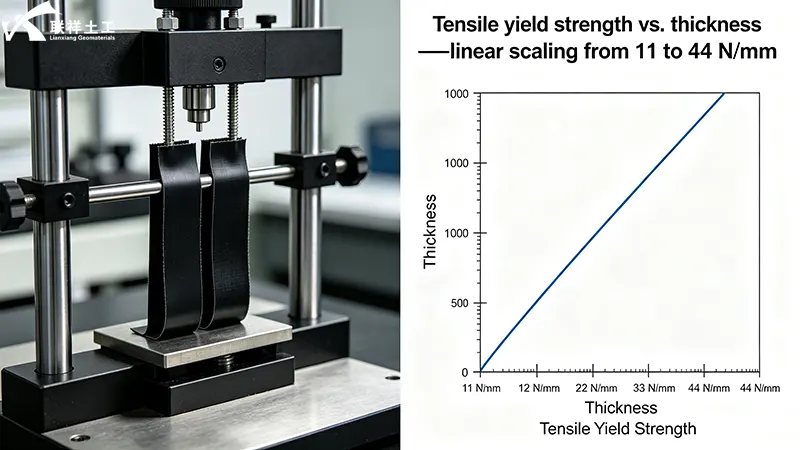
ASTM D6693 specifies the test method for tensile properties of geomembranes using a Type IV specimen. This standard measures both yield strength and break strength in both machine direction (MD) and cross-machine direction (XMD).
Tensile yield strength data by thickness:
| Thickness (mm) | Yield Strength (N/mm) | Break Strength (N/mm) |
| 0.75 | ≥ 11 | ≥ 20 |
| 1.00 | ≥ 15 | ≥ 27 |
| 1.25 | ≥ 18 | ≥ 33 |
| 1.50 | ≥ 22 | ≥ 40 |
| 2.00 | ≥ 29 | ≥ 53 |
| 2.50 | ≥ 37 | ≥ 67 |
| 3.00 | ≥ 44 | ≥ 80 |
Break elongation must reach at least 700%, demonstrating the material's ability to stretch without failing under stress.
Key takeaway: Tensile strength scales with thickness—roughly 4 N/mm increase per 0.25mm of thickness. A 3.0mm liner has four times the yield strength of a 0.75mm liner.
Standard 4: ASTM D1004 – Tear Resistance
ASTM D1004 measures tear resistance (right-angle tear strength). This property is critical for resisting propagation of tears during installation and service.
Tear resistance data by thickness:
| Thickness (mm) | Tear Resistance (N) |
| 0.75 | ≥ 93 |
| 1.00 | ≥ 125 |
| 1.25 | ≥ 160 |
| 1.50 | ≥ 190 |
| 2.00 | ≥ 250 |
| 2.50 | ≥ 315 |
| 3.00 | ≥ 375 |
Standard 5: ASTM D4833 – Puncture Resistance
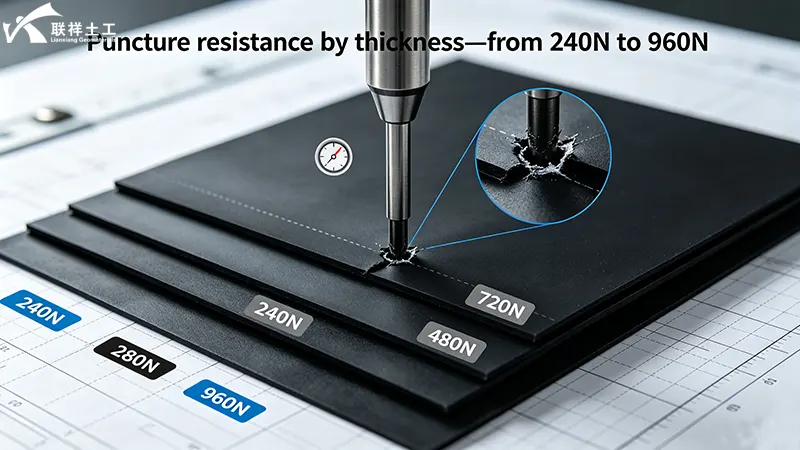
ASTM D4833 measures puncture resistance—the force required to puncture the geomembrane. This is one of the most important properties for applications where the liner will be exposed to sharp objects, rocks, or heavy equipment.
Puncture resistance data by thickness:
| Thickness (mm) | Puncture Resistance (N) |
| 0.75 | ≥ 240 |
| 1.00 | ≥ 320 |
| 1.25 | ≥ 400 |
| 1.50 | ≥ 480 |
| 2.00 | ≥ 640 |
| 2.50 | ≥ 800 |
| 3.00 | ≥ 960 |
Key takeaway: A 2.0mm liner has nearly three times the puncture resistance of a 0.75mm liner—a critical consideration for mining and heavy-duty applications.
Standard 6: ASTM D3895 / D5885 – Oxidative Induction Time (OIT)
Oxidative Induction Time (OIT) measures the antioxidant content of the geomembrane—essentially, how long the material can resist oxidation before degradation begins.
GRI-GM13 requirements:
| Parameter | Minimum Requirement | Test Method |
| Standard OIT | ≥ 100 minutes | ASTM D3895 |
| High-Pressure OIT | ≥ 400 minutes | ASTM D5885 |
UV resistance requirements (OIT retention after 1,600 hours of UV exposure):
| Parameter | Requirement |
| Standard OIT retained after 1,600 hrs | ≥ 50% |
| High-Pressure OIT retained after 1,600 hrs | ≥ 50% |
Oven aging (85°C, 90 days): Standard OIT retained ≥ 55%
Critical insight: Studies show that after extended UV exposure (8,760 hours), Standard OIT values can decrease by as much as 89% compared to virgin material. This is why UV resistance testing—and proper carbon black content—is non-negotiable for exposed applications.
Standard 7: ASTM D5397 – Stress Crack Resistance (SCR)
Stress crack resistance is arguably the most important long-term durability indicator for HDPE geomembranes. It measures the material's resistance to brittle failure under sustained stress—the leading cause of premature geomembrane failure.
GRI-GM13 requirement: ≥ 500 hours (single-point notched constant tensile load test)
How the standard has evolved:
| Era | Requirement |
| 1990s | 200 hours |
| 2000s | 300 hours |
| Current (GM13) | 500 hours |
Premium products: Some high-performance HDPE geomembranes now exceed 1,000 hours without failure.
Key takeaway: Stress crack resistance has more than doubled over the last 30 years. Specifying a product that only meets the old 300-hour standard—when 500 hours is now the minimum—is a significant risk.
Standard 8: ASTM D1603 / D4218 – Carbon Black Content
Carbon black is added to HDPE geomembranes primarily for UV protection. Without it, the material would degrade rapidly under sunlight.
GRI-GM13 requirement: 2.0% to 3.0% carbon black by weight
Key considerations:
- Carbon black content below 2% provides inadequate UV protection
- Content above 3% can compromise mechanical properties
- Dispersion quality matters as much as content—carbon black must be uniformly distributed (typically A-1, A-2, or B-1 per ASTM D2663)
Key takeaway: "2-3% carbon black" is a standard specification—but ask for dispersion test results, not just content percentage.
Standard 9: GRI-GM42 – High-Performance HDPE for Extreme Conditions
Introduced in April 2025, GRI-GM42 represents the next generation of HDPE geomembrane specifications. It addresses the limitations of GM13 for extreme applications.
GRI-GM42 requirements:
| Parameter | Requirement |
| Formulated sheet density | ≥ 0.945 g/ml (vs. GM13's 0.940) |
| Thickness range | 1.5 mm to 3.0 mm (60 to 120 mil) |
| Surface types | Smooth and textured |
| Stress crack resistance | ≥ 1,500 hours |
Why GRI-GM42 matters:
- Outstanding resistance to high temperatures
- Superior chemical resistance
- Enhanced antioxidant depletion resistance
- Exceptional stress cracking resistance
- Superior mechanical properties beyond conventional HDPE
Key takeaway: For critical containment applications—hazardous waste, aggressive chemicals, extreme temperatures—GRI-GM42 represents a significant upgrade over GM13. The higher density (0.945+ g/ml) and 1,500-hour stress crack requirement provide a substantial safety margin.
Thickness Selection Guide by Application
With the standards understood, here's how thickness selection maps to real-world applications:
| Application | Recommended Thickness | Key Considerations |
| Agricultural ponds / aquaculture | 0.5 – 1.0 mm | Water depth, animal activity, cleaning tools |
| Water reservoirs / canals | 1.0 – 1.5 mm | Water pressure, installation conditions |
| Landfill bottom liners | 1.5 – 2.0 mm | Chemical resistance, mechanical stress |
| Landfill slopes | 1.5+ mm (textured) | Friction, waste mass movement |
| Mining tailings ponds | 1.5 – 2.5 mm | Abrasion, loading conditions |
| Heap leach pads | 2.0 – 3.0 mm | Acid containment, heavy loads |
| Hazardous waste | ≥ 2.0 mm (double-layer) | Stringent impermeability |
| Industrial chemical storage | ≥ 2.0 mm | Strong acids, bases, oils |
Landfills, chemical waste ponds, and mining operations typically require a minimum of 1.5 mm—or even 2.0 mm—HDPE geomembrane, especially under national environmental regulations.
Quick Reference: Top 9 Standards at a Glance
| # | Standard | What It Measures | Key Requirement |
| 1 | GRI-GM13 (Rev. 19) | Overall HDPE specification | ≥0.940 g/cc density; 0.75–3.0 mm |
| 2 | ASTM D5199 | Thickness | ±10% tolerance |
| 3 | ASTM D6693 | Tensile strength | 11–44 N/mm yield (by thickness) |
| 4 | ASTM D1004 | Tear resistance | 93–375 N (by thickness) |
| 5 | ASTM D4833 | Puncture resistance | 240–960 N (by thickness) |
| 6 | ASTM D3895/D5885 | OIT (antioxidants) | ≥100 min (Std); ≥400 min (HP) |
| 7 | ASTM D5397 | Stress crack resistance | ≥500 hours |
| 8 | ASTM D1603/D4218 | Carbon black content | 2.0–3.0% |
| 9 | GRI-GM42 (2025) | High-performance HDPE | ≥0.945 g/cc; ≥1,500 hr SCR |
Final Thoughts
Selecting an HDPE geomembrane in 2026 requires more than just specifying a thickness. It requires understanding the interplay of nine key standards—from GRI-GM13's baseline requirements to GRI-GM42's high-performance thresholds—and how each property translates to real-world performance.
Remember:
- GRI-GM13 Revision 19 (June 2025) is the current baseline
- GRI-GM42 (April 2025) offers premium performance for extreme conditions
- Mechanical properties scale with thickness—but thickness alone doesn't guarantee quality
- Carbon black, OIT, and stress crack resistance are the three most critical long-term durability indicators
- Always request third-party test reports—not just manufacturer claims
The cheapest liner is rarely the best value. A liner that fails in five years will cost far more in repairs, environmental penalties, and lost production than a properly specified liner that performs for decades.
Lianxiang Group supplies certified HDPE geomembranes meeting GRI-GM13 and GRI-GM42 standards, in thicknesses from 0.75mm to 3.0mm, with smooth and textured options. Our technical team can help you select the right specification for your specific site conditions and project requirements. Contact us for free samples, technical data sheets, or a customized quote.
Written by
SHANDONG LIANXIANG ENGINEERING MATERIALS CO., LTD.
Kyle Fan
WhatsApp:+86 139 5480 7766
Email:admin@lianxiangcn.com
-
WhatsApp
-
E-MailE-Mail:admin@lianxiangcn.com
-
WeChatWeChat:18554180188