
- Home
- Company
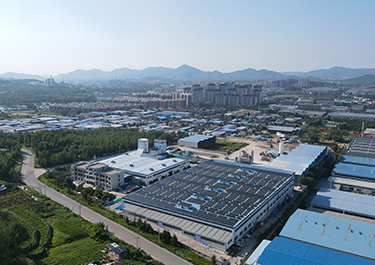 Our FactoryWe have a team of more than 30 talented geotechnical material R&D experts and a 30,000 square meter advanced modern intelligent manufacturing plant.
 - Products
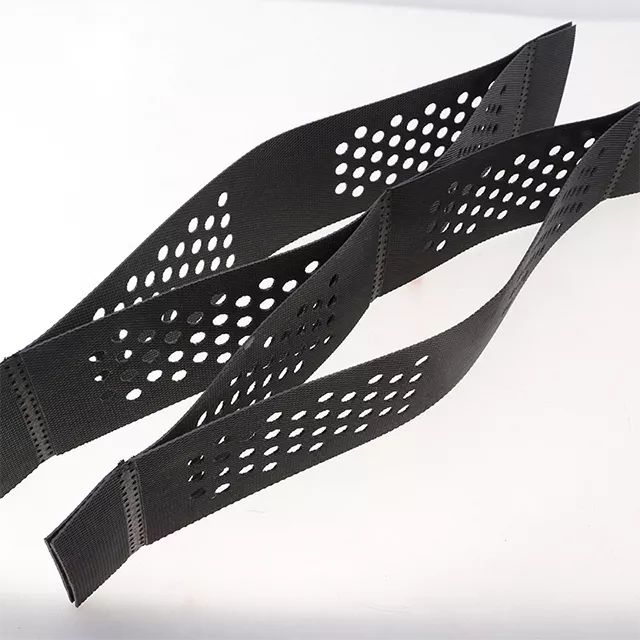 Geocell is a three-dimensional mesh structure made of high-strength polymer sheets (such as HDPE, PP, etc.) through ultrasonic welding. When unfolded, it presents a three-dimensional grid shape.
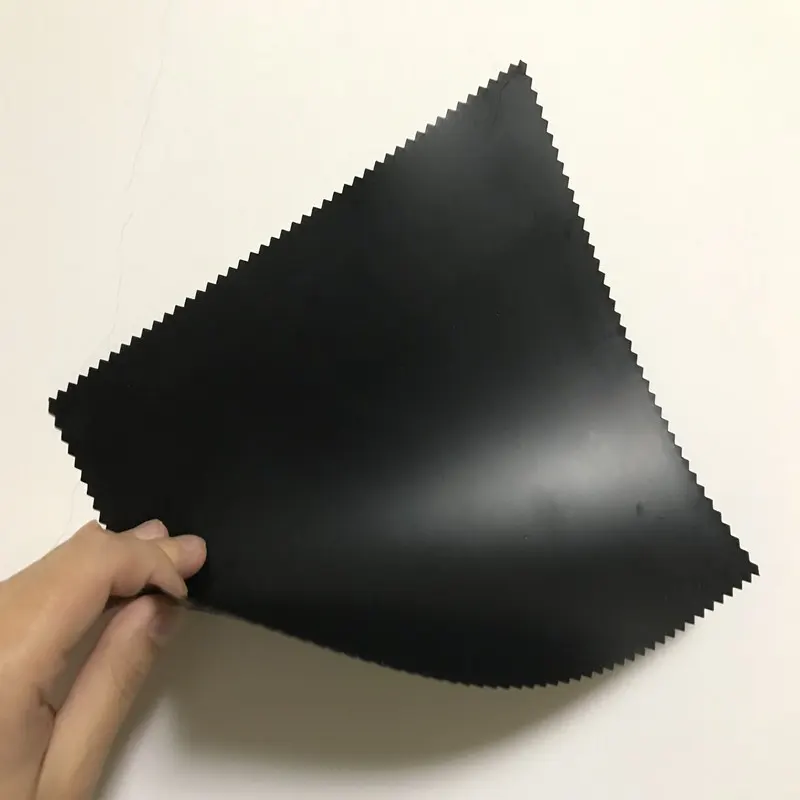 Geomembrane is a thin, extremely low-permeability sheet material made from high-molecular-weight polymers (high-density polyethylene, linear low-density polyethylene).
 - Blog
- Contacts
Geocell vs Geogrid: 6 Key Differences for Soil Stabilization


Geocell vs geogrid – which is right for your soil stabilization project? Explore 6 critical differences in structure, mechanism, applications, and performance. Lianxiang Group offers expert guidance and high-quality geosynthetics.
When it comes to soil stabilization and ground reinforcement, geocell and geogrid are two of the most widely used geosynthetic materials. While both are designed to improve soil performance, they operate on fundamentally different principles and are suited for different applications.
Choosing the wrong material can lead to underperformance, over-engineering, or even project failure. Here are the 6 key differences every engineer and contractor should understand.
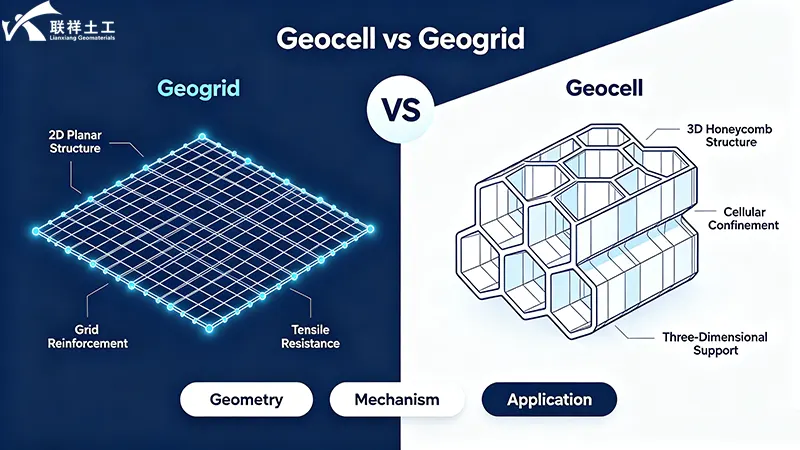
Difference 1: Structural Dimension – 2D Planar vs. 3D Cellular
This is the most fundamental distinction between the two materials.
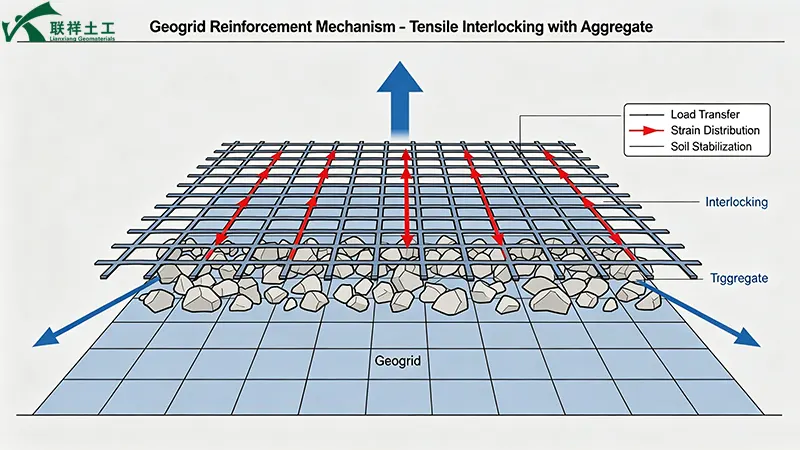
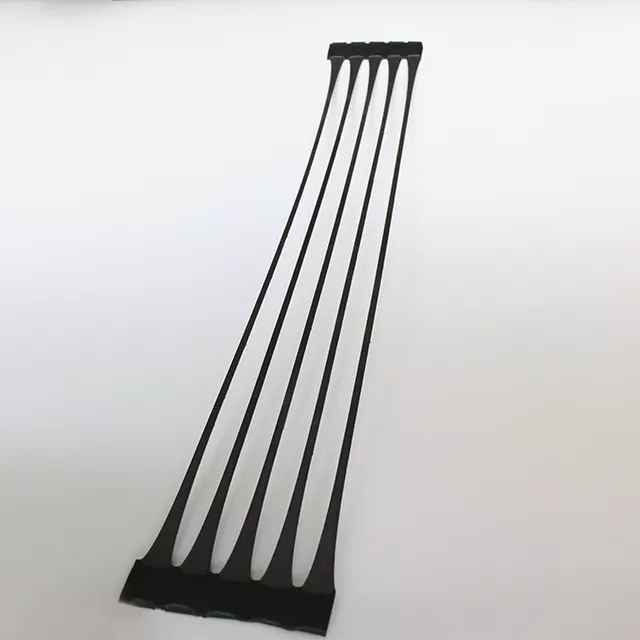
Geogrid is a two-dimensional (2D) planar grid structure. Made from polymer materials such as polypropylene or polyester, it features regular grid openings and works primarily through in-plane tension.
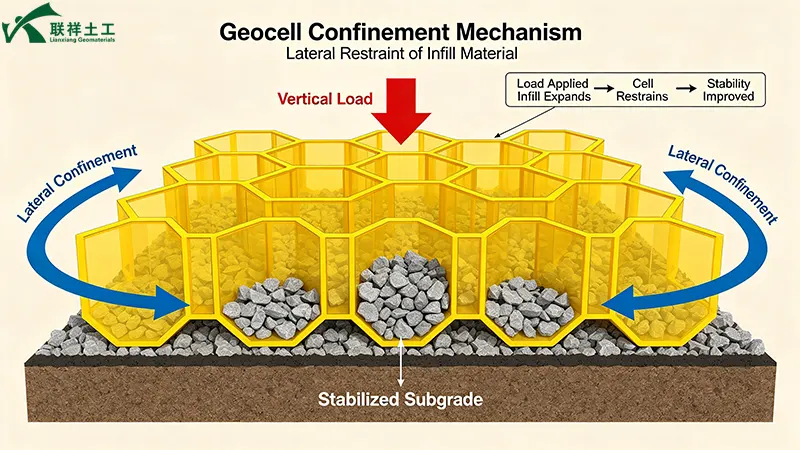
Geocell is a three-dimensional (3D) honeycomb-like structure. Manufactured from high-density polyethylene (HDPE) strips connected by ultrasonic welding, it expands to form a series of interconnected cells with a significant thickness (typically 100–300 mm). This third dimension gives geocell bending stiffness and allows it to function like a "shallow foundation" , effectively distributing vertical loads.
| Feature | Geogrid | Geocell |
| Dimension | 2D (planar) | 3D (cellular) |
| Thickness | Minimal (few mm) | 100–300 mm |
| Structure | Flat grid with apertures | Honeycomb cells |
Difference 2: Reinforcement Mechanism – Tensile vs. Confinement
Geogrid works primarily through tensile reinforcement. The grid interlocks with the surrounding aggregate or soil, creating a mechanically stabilized layer that increases the soil's load-bearing capacity and reduces deformation. The reinforcement effect is largely horizontal.
Geocell works through 3D confinement. When cells are filled with compacted soil or aggregate, the cell walls constrain the infill material laterally, preventing lateral spreading. This confinement increases the shear strength and stiffness of the infill material, creating a composite mattress that distributes loads vertically and laterally.
| Feature | Geogrid | Geocell |
| Reinforcement type | Tensile (horizontal) | 3D confinement (vertical + lateral) |
| Load distribution | Planar | Spatial (like a mat foundation) |
| Key mechanism | Interlocking & tension | Lateral restraint & stress dispersion |
Difference 3: Load-Bearing Capacity – Different Approaches to Heavy Loads
Both materials improve load-bearing capacity, but through very different means.
Geogrid works best under uniform, planar loading such as paved roads, railways, and parking lots. It creates a reinforced soil mass that spreads loads horizontally, reducing stress on the subgrade. However, its load-bearing improvement is largely dependent on the quality of the aggregate fill.
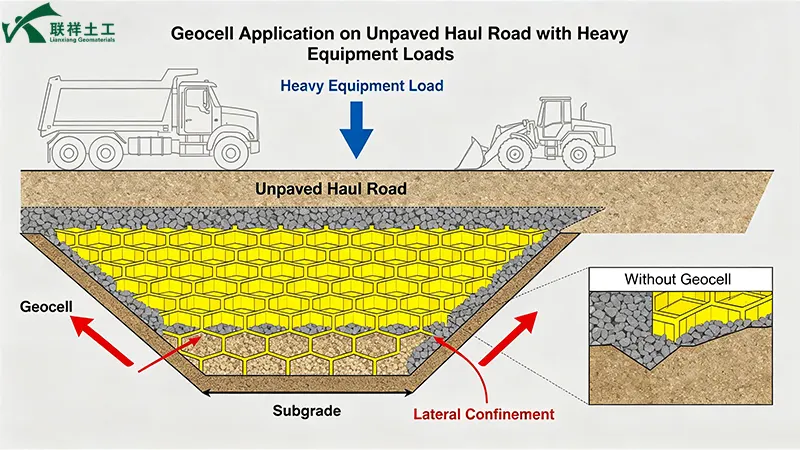
Geocell excels under concentrated or cyclic loads such as heavy machinery, crane pads, or unpaved haul roads. The cellular confinement creates a rigid composite structure that can support wheel loads as high as 40 tonnes in heavy-duty applications. Even with poor-quality infill materials, geocell can significantly enhance performance.
| Feature | Geogrid | Geocell |
| Ideal load type | Uniform/planar loads | Concentrated/cyclic loads |
| Performance with poor fill | Limited improvement | Significant improvement |
| Typical load capacity | Up to moderate heavy loads | Up to 40+ tonnes (heavy-duty) |
Difference 4: Application Scenarios – Where Each Excels
Understanding where each material performs best is critical for proper specification.
Geogrid is typically used for:
- Road and railway base reinforcement – stabilizing granular layers
- Retaining walls and steep slopes – providing tensile reinforcement
- Pavement overlay – reducing reflective cracking
- Working platforms – over soft soils
Geocell is typically used for:
- Unpaved roads and haul roads – over very soft subgrades
- Slope protection and erosion control – on steep embankments
- Channel protection – against water flow erosion
- Load support pads – for cranes, drilling rigs, and temporary access roads
- Green infrastructure – vegetated slopes and retaining walls
The choice often comes down to:
| Condition | Recommended |
| Paved road base / uniform load | Geogrid |
| Unpaved haul road / concentrated load | Geocell |
| Soft subgrade (CBR < 3%) | Geocell |
| Moderate subgrade (CBR 3–5%) | Geogrid or Geocell (depending on load) |
| Slope protection / erosion control | Geocell |
| Retaining wall reinforcement | Geogrid |
Difference 5: Infill Material Flexibility – One is More Forgiving
The type of infill material available on site can significantly influence material selection.
Geogrid requires well-graded, high-quality granular fill (such as crushed stone or gravel) to achieve proper interlock. The performance of a geogrid-reinforced layer is highly dependent on the friction and interlock between the grid and the aggregate. Poor-quality fill significantly reduces its effectiveness.
Geocell is much more forgiving with infill materials. It can effectively confine a wide range of infill types, including:
- Native soil (clay, sand, silt)
- Poor-quality on-site materials
- Recycled concrete or demolition waste
- Lightweight materials (expanded clay, foamed glass)
This flexibility can result in significant material cost savings, especially on remote sites where importing high-quality aggregate is expensive.
| Feature | Geogrid | Geocell |
| Fill material requirement | High-quality granular | Wide range – including native soil |
| Sensitivity to fill quality | High | Low |
| Cost-saving potential | Limited (requires imported fill) | High (can use on-site material) |
Difference 6: Cost and Installation – Time vs. Material Savings
Cost considerations go beyond just the unit price of the material.
Geogrid is generally less expensive per square metre and faster to install. It is rolled out in long sheets and can be covered immediately with aggregate. However, the need for high-quality imported fill often adds to the overall project cost.
Geocell has a higher initial material cost and takes more time to install. The panels must be expanded, anchored, and filled layer by layer. However, geocell allows the use of cheaper, locally available infill – which can reduce or eliminate costly fill importation and off-site disposal. This often leads to lower total project cost in many applications, particularly on soft subgrades.
| Feature | Geogrid | Geocell |
| Material cost | Lower | Higher |
| Installation speed | Faster | Slower (requires cell expansion and layer filling) |
| Total project cost | Lower fill quality sensitivity | Often lower overall due to fill savings |
| Key trade-off | More expensive fill | More expensive material – cheaper fill |
Quick Reference: Geocell vs Geogrid – 6 Key Differences at a Glance
| Factor | Geogrid (2D) | Geocell (3D) |
| Dimension | 2D planar grid | 3D honeycomb structure |
| Reinforcement mechanism | Tensile / interlocking | 3D confinement / stress distribution |
| Load types | Uniform / planar | Concentrated / cyclic / heavy |
| Ideal applications | Roads, railways, retaining walls | Unpaved roads, slopes, load pads, erosion control |
| Fill material flexibility | Requires high-quality aggregate | Can use native soil and poor-quality fill |
| Cost structure | Lower material cost – higher fill cost | Higher material cost – lower fill cost |
When to Use Which? – A Simple Decision Framework
Choose Geogrid when:
- Your project involves paved roads or railways with uniform loads
- You have easy access to high-quality granular fill
- The subgrade has moderate bearing capacity (CBR > 3%)
- You need fast installation and minimal site disruption
- You are building retaining walls or steep slopes requiring horizontal reinforcement
Choose Geocell when:
- Your project involves unpaved haul roads, crane pads, or heavy equipment access
- You have weak subgrade (CBR < 3%) or soft soil conditions
- You want to use on-site native soil as infill to save costs
- You need erosion control on steep slopes or channels
- The project faces concentrated or cyclic heavy loads
Final Thoughts
Geogrid and geocell are not competitors – they are complementary tools in the geosynthetics toolbox. Understanding their differences allows engineers to select the most efficient and cost-effective solution for each specific project condition.
In many cases, the choice is about balancing fill quality, load conditions, installation speed, and site constraints. When in doubt, a site-specific evaluation of subgrade conditions, load requirements, and available materials will point you in the right direction.
Lianxiang Group supplies high-quality geocell, geogrid, geomembrane, and geotextile solutions for civil and environmental projects worldwide. Our technical team is ready to help you select the right material for your specific soil conditions and load requirements. Contact us for free samples, technical data, or a customized solution.
Written by
SHANDONG LIANXIANG ENGINEERING MATERIALS CO., LTD.
Kyle Fan
WhatsApp:+86 139 5480 7766
Email:admin@lianxiangcn.com
-
WhatsApp
-
E-MailE-Mail:admin@lianxiangcn.com
-
WeChatWeChat:18554180188