
- Home
- Company
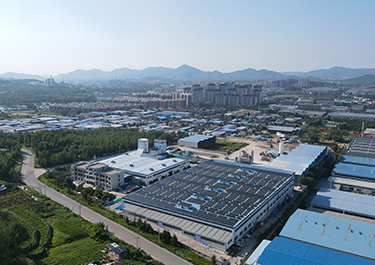 Our FactoryWe have a team of more than 30 talented geotechnical material R&D experts and a 30,000 square meter advanced modern intelligent manufacturing plant.
 - Products
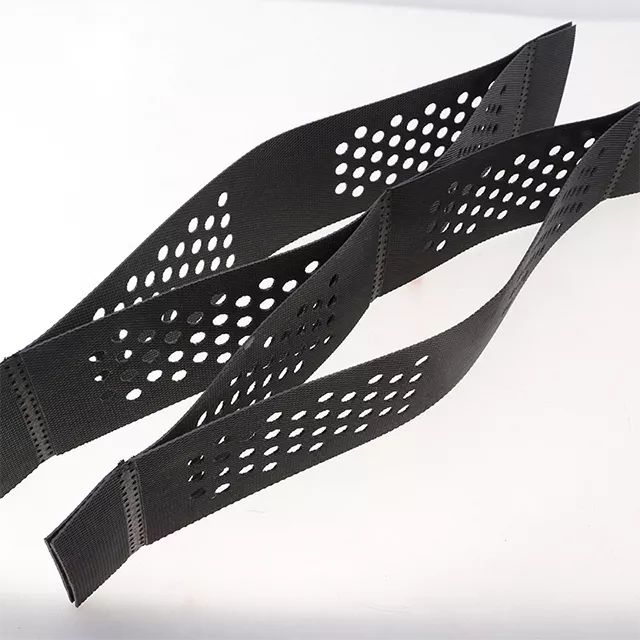 Geocell is a three-dimensional mesh structure made of high-strength polymer sheets (such as HDPE, PP, etc.) through ultrasonic welding. When unfolded, it presents a three-dimensional grid shape.
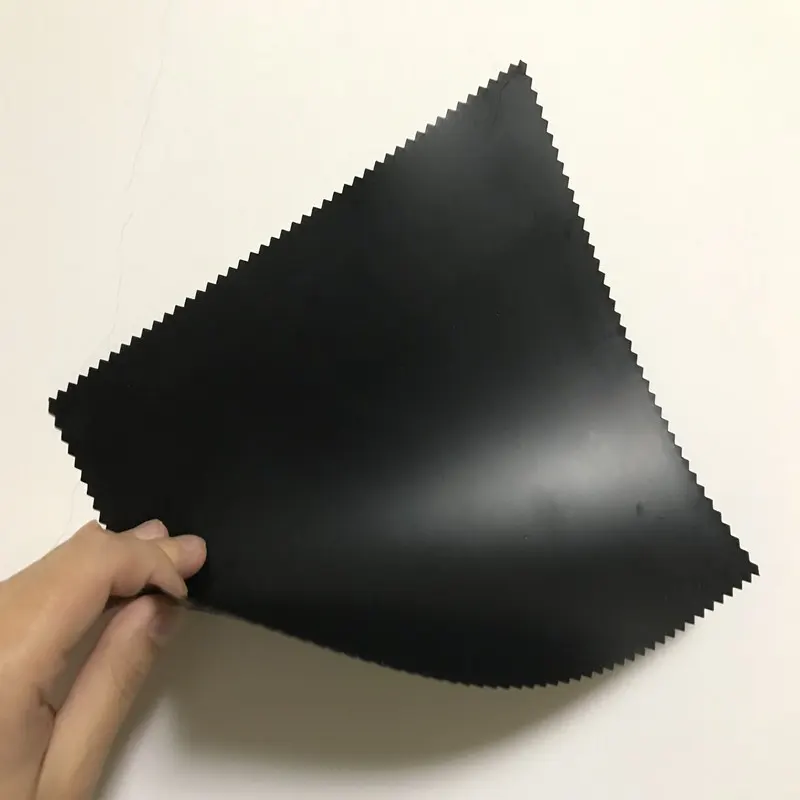 Geomembrane is a thin, extremely low-permeability sheet material made from high-molecular-weight polymers (high-density polyethylene, linear low-density polyethylene).
 - Blog
- Contacts
Aquaculture HDPE Geomembrane: Top 7 Pond Lining Benefits & Specs


Discover the top 7 benefits of HDPE geomembrane for aquaculture ponds—water conservation, disease control, higher yields, and more. Learn key specs and expert installation tips. Lianxiang Group supplies premium aquaculture-grade HDPE liners worldwide.
For decades, earthen ponds were the default choice for aquaculture. But farmers and operators have long known the painful reality: water seeps away, soil-borne pathogens invade, and harvesting becomes a muddy, labor-intensive mess.
In unlined earthen ponds, seepage losses often reach 30–60%. Water is pumped in—only to disappear into the ground. Chemicals and medications leach out. Harmful heavy metals and pathogens from the subsoil infiltrate the culture water. The result? Higher operating costs, lower survival rates, and inconsistent yields.
Enter the HDPE geomembrane—a high-density polyethylene liner that has become the gold standard for modern aquaculture. Today, HDPE geomembranes account for 65–78% of installed commercial pond lining volume, and for good reason.
Here are the top 7 benefits of using HDPE geomembrane in aquaculture ponds—backed by performance data and real-world results.
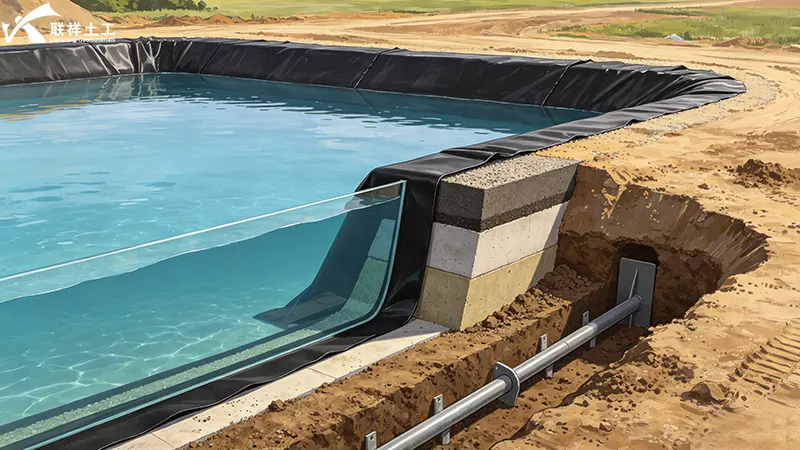
1. Superior Water Conservation – Slash Pumping Costs by 30%+
Water is the lifeblood of aquaculture—and also one of its largest ongoing expenses. In earthen ponds, seepage is relentless: water constantly migrates into the surrounding soil, forcing operators to pump continuously to maintain stable water levels.
How HDPE geomembrane solves it: With an ultra-low permeability coefficient of < 10 -13 cm/s—effectively near-zero permeability—an HDPE liner creates a complete hydraulic barrier. Water stays in the pond. Period.
The data: Facilities that installed HDPE liners in fish breeding ponds reduced water loss by over 30%. This translates directly into lower pumping costs, reduced electricity consumption, and more predictable water management.
The result: Less water pumped, lower energy bills, and a farming operation that's far more resilient during dry seasons.
2. Superior Water Quality Control – Cleaner Water, Healthier Stock
In an earthen pond, the water is in constant contact with soil—and everything in it. Heavy metals (acid, iron, nickel, copper, mercury, lead), antibiotics, and other contaminants can leach from the soil into the water. Sediment clouds the water. Algae blooms run unchecked.
How HDPE geomembrane solves it: The liner creates a complete physical barrier between the pond water and the underlying soil. It effectively isolates the aquaculture water from the external environment, preventing harmful substances from seeping in while also stopping fertilizers and medications from polluting groundwater.
Additional advantages:
- The smooth HDPE surface reduces algae buildup and makes pond cleaning much easier
- The black color absorbs heat, helps maintain stable water temperatures, and inhibits algae growth under the liner
- Reduced water-soil exchange enables precise control over temperature, pH, and nutrient levels
The result: Cleaner water, fewer algae problems, and a more stable aquatic environment that promotes healthier fish and shrimp.
3. Disease Prevention & Biosecurity – Breaking the Pathogen Cycle
Disease is the single greatest threat to aquaculture profitability. In earthen ponds, pathogens persist in the soil from one cycle to the next. Disease carry-over between cycles is a constant battle.
How HDPE geomembrane solves it: The liner creates a biosecure environment. After each harvest, the pond drains completely, leaving a clean, smooth bottom that can be rapidly sun-dried and disinfected. This breaks the disease cycle—pathogens have nowhere to hide.
The data: By using HDPE liners, operators can reduce the chance of fish getting sick by blocking heavy metals and other contaminants from the water environment. The isolation from soil also reduces disease risk and boosts overall yield.
The result: Fewer disease outbreaks, lower mortality rates, and reduced reliance on antibiotics and chemicals.
4. Higher Yields & Faster Harvest Cycles – Up to 20% More Production
Time is money in aquaculture. The faster you can complete a harvest cycle, the more production you can achieve per year.
How HDPE geomembrane solves it: The smooth, non-porous surface makes harvesting dramatically faster and easier. No more dragging nets through mud. No more struggling to separate fish from sediment. The pond bottom stays clean.
The data: Operators report that HDPE-lined ponds increase the harvest cycle per year by more than 20%. The time saved, combined with reduced disease risk, naturally increases farmer income.
Additional efficiency gains:
- Easier pond cleaning and disinfection between cycles
- Faster pond drying after draining
- More precise control over stocking densities due to stable water volumes
The result: More harvests per year, higher total production, and better return on investment.
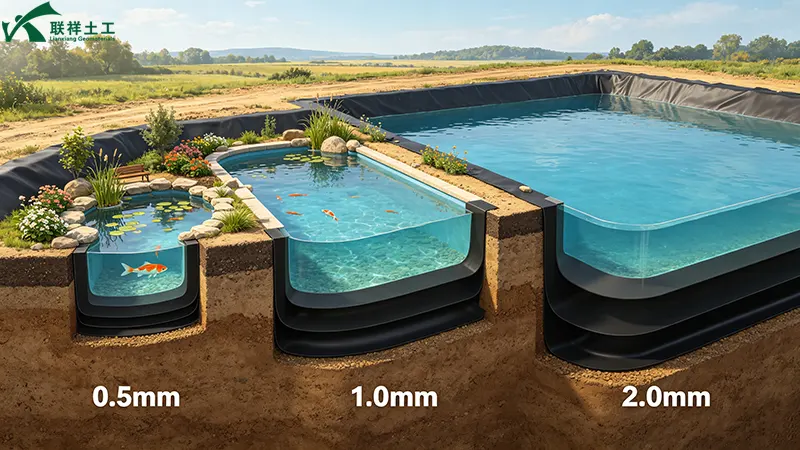
5. Long-Term Durability – 20–50 Years of Exposed Service Life
A pond liner is a long-term investment. You don't want to replace it every few years.
How HDPE geomembrane delivers: HDPE geomembranes are engineered for extreme durability. With 2–3% carbon black UV stabilization, they resist degradation even under continuous outdoor sunlight exposure.
Service life data:
- Exposed applications: 20–50 years
- Buried applications: 50–100+ years
- Field performance: Exhumed commercial pond samples have demonstrated 30–70 years of proven performance (GSI database, 2023–2026)
What this means for you: One properly installed HDPE liner can outlast multiple generations of farming operations. The maintenance cost of a fish pond lined with HDPE can be reduced for 20–30 years.
The result: A single investment that delivers decades of reliable performance—with minimal ongoing maintenance.
6. Chemical & Biological Resistance – Withstanding the Harsh Aquaculture Environment
Aquaculture ponds are harsh environments. Fish waste, residual feed, medications, fertilizers, algae, and bacteria all take their toll on pond liners.
How HDPE geomembrane withstands it: HDPE has strong resistance to water, salts, most acids, alkalis, oils, and organic substances. It will not be corroded or degraded by fish excreta, residual feed, or pond water itself.
Key performance data:
- Chemical stability: Stable across pH 2–13
- Salt resistance: Performs in salinity up to 45 ppt
- Welded seam strength: Achieves ≥90–95% of parent material strength
- UV resistance: Retains performance even in tropical climates
The result: A liner that doesn't degrade, doesn't leach harmful chemicals, and doesn't need frequent replacement—even in demanding saltwater or chemical-treated environments.
7. Rapid ROI – Cost Recovery Within 1–3 Production Cycles
The upfront cost of an HDPE liner is higher than an earthen pond. But the payback is remarkably fast.
How the math works: Although the initial investment is higher, savings on water, electricity, and chemicals—coupled with improved survival rates and yields—typically allow for cost recovery within 1–3 production cycles.
The cost advantage:
- Installed cost: USD 1.20–5.50/m2
- Payback period vs. concrete or clay lining: Often 1–4 years
- Watertightness: Compliant 1.0–2.0 mm HDPE liners achieve >98–99.9% watertightness with proper installation
Long-term economics: Over a 20-year horizon, an HDPE-lined pond is dramatically more cost-effective than repeatedly repairing and maintaining an earthen pond.
The result: A capital investment that pays for itself within one to three production cycles—and continues delivering returns for decades.
Specifications: What to Look For in an Aquaculture-Grade HDPE Geomembrane
Choosing the right specifications is critical. Here are the key parameters:
Thickness Selection
| Thickness | Recommended Application |
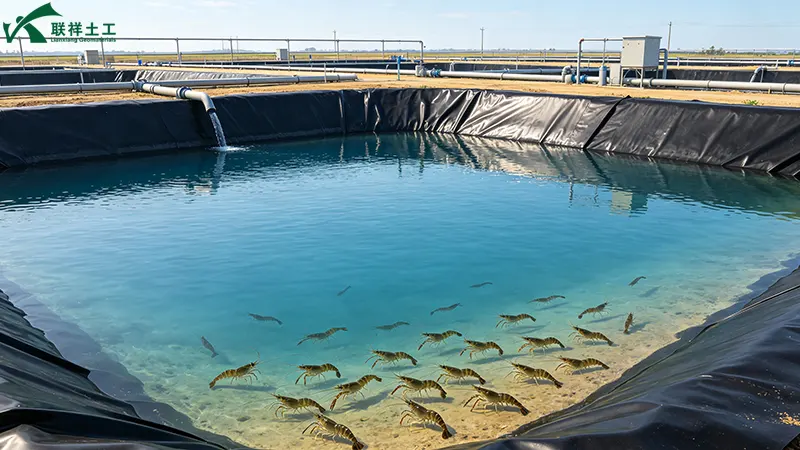
| 0.5mm (500 micron) | Standard shrimp and fish ponds on prepared beds |
| 0.75mm (750 micron) | General aquaculture ponds |
| 1.0mm | Larger reservoirs, rough subgrades, heavy aeration |
| 1.5mm+ | Deep ponds, rough terrain, high-risk applications |
General rule: Shallow ponds/shrimp ponds: 0.5–0.8mm is usually sufficient. Deep fish ponds or ponds with burrowing organisms (crabs, turtles): 0.8–1.0mm is recommended for better puncture resistance.
Material Quality – Virgin Resin is Non-Negotiable
Always choose 100% virgin HDPE resin. Virgin material provides:
- Higher mechanical strength
- Better elongation
- Greater resistance to puncture and environmental stress
Critical warning: Beware of cheap liners with high recycled content. They have inferior strength, durability, and are prone to damage. Recycled materials may contain contaminants, inconsistent polymer blends, and degraded additives that compromise long-term performance.
Key Performance Specifications (ASTM GRI-GM13 Standard)
| Property | 0.5mm | 0.75mm | 1.0mm | 1.5mm | 2.0mm |
| Density | ≥0.940 g/cc | ≥0.940 g/cc | ≥0.940 g/cc | ≥0.940 g/cc | ≥0.940 g/cc |
| Yield Strength | ≥7 KN/m | ≥10 KN/m | ≥13 KN/m | ≥20 KN/m | ≥26 KN/m |
| Break Strength | ≥10 KN/m | ≥15 KN/m | ≥20 KN/m | ≥30 KN/m | ≥40 KN/m |
| Puncture Resistance | ≥120 N | ≥180 N | ≥240 N | ≥360 N | ≥480 N |
| Tear Resistance | ≥56 N | ≥84 N | ≥115 N | ≥170 N | ≥225 N |
| Carbon Black Content | 2.0–3.0% | 2.0–3.0% | 2.0–3.0% | 2.0–3.0% | 2.0–3.0% |
Surface Type Options
| Surface | Best For |
| Smooth | General-purpose, easy to weld |
| Textured | Sandy soils or steep embankments—increases friction to prevent slippage |
Color Considerations
| Color | Advantage |
| Black | Most common. Absorbs heat, maintains water temperature, inhibits algae growth |
| Blue/White | Reflects sunlight, lowers water temperature—suitable for cold-water fish or hot climates |
Pond Laying Tips: 5 Steps to a Professional Installation
A high-quality liner installed poorly will fail. Follow these steps for a durable, leak-free installation.
Step 1: Subgrade Preparation
This is the foundation that determines the durability of the entire liner system.
- Clear the site: Remove all sharp objects—rocks, tree roots, snail shells, and debris that could puncture the liner
- Level and compact: The pond bottom and slopes must be leveled and thoroughly compacted
- Design slope: Create a slight slope toward a central siphon pit for efficient waste collection
- Excavate anchor trench: Dig a trench 40–50cm deep and 40–50cm wide along the pond edge to secure liner edges
Step 2: Liner Deployment
- Plan layout: Position liner rolls to minimize the number of cross-seams
- Unroll carefully: Use specialized equipment or manual labor. Deploy during cool weather (early morning or late afternoon) to limit thermal expansion
- Lay flat: The liner must lie flat against the substrate, with edges overlapping 10–15cm for welding
- Order extra material: Add roughly 10–15% over the flat pond footprint to cover slopes, anchor trenches, and weld overlaps
Step 3: Welding – The Critical Step
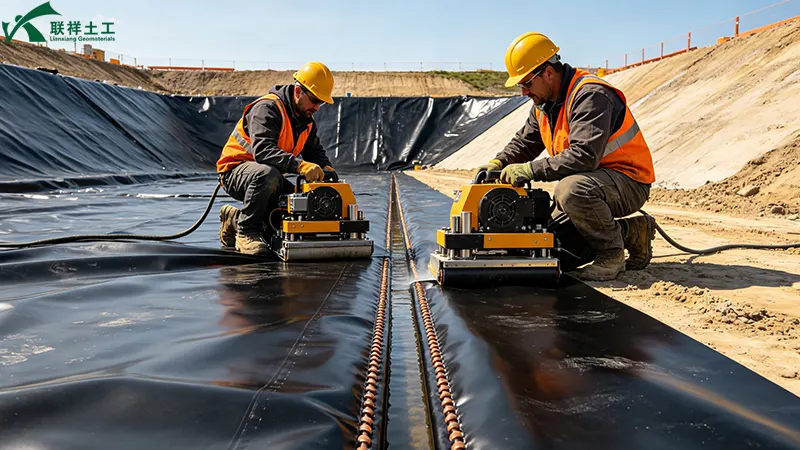
Quality welding is non-negotiable. Two methods are used:
| Method | Application |
| Double Hot-Wedge Welding | Straight seams connecting liner panels. Creates a double weld track with an air channel in the middle for pressure testing |
| Extrusion Welding | Tight corners, complex details, bank edges, and pipe connections. Uses molten HDPE resin to completely seal joints |
For pipe penetrations: Cut a tight collar and extrusion-weld a boot around it—this is the leak most people miss.
Step 4: Anchoring
- Place liner edges into the pre-dug anchor trench
- Backfill with soil and compact tightly to lock the liner edges in place
- This prevents wind uplift and liner slippage when filled with water
Step 5: Quality Inspection – Test Every Seam
Do not skip this step. A virtual weld that looks fine but leaks is the classic post-fill failure.
- Air Pressure Testing: Pump air into the channel between the double weld tracks to verify integrity
- Vacuum Box Testing: For extrusion welds
- Fill slowly: When first filling, add water slowly so the liner settles into the contours as the water rises
Quick Reference: Top 7 Benefits at a Glance
| # | Benefit | Key Data |
| 1 | Water Conservation | Reduces water loss by >30% |
| 2 | Water Quality Control | Permeability < 10-13 cm/s; isolates soil contaminants |
| 3 | Disease Prevention | Breaks pathogen cycle; reduces disease risk |
| 4 | Higher Yields | Increases harvest cycles by >20% |
| 5 | Long-Term Durability | 20–50 years exposed; 50–100+ years buried |
| 6 | Chemical Resistance | Stable pH 2–13; salt up to 45 ppt |
| 7 | Rapid ROI | Cost recovery within 1–3 production cycles |
Final Thoughts
Aquaculture is evolving. The days of struggling with leaky earthen ponds, uncontrolled diseases, and labor-intensive harvests are coming to an end. HDPE geomembranes have emerged as the industry standard—and for good reason.
From 30%+ water savings and 20%+ faster harvest cycles to 50-year durability and rapid ROI within 1–3 production cycles, the benefits are measurable, proven, and transformative.
Remember:
- Always choose 100% virgin HDPE resin—recycled content is a false economy
- Match thickness to your specific application—0.5mm for standard shrimp ponds, 1.0mm for larger reservoirs or rough subgrades
- Installation quality matters as much as material quality—invest in proper subgrade prep, professional welding, and thorough seam testing
The upfront investment in an HDPE liner is real—but the long-term savings, increased production, and peace of mind are far greater.
Lianxiang Group supplies aquaculture-grade HDPE geomembranes made from 100% virgin resin, in thicknesses from 0.5mm to 2.0mm, with smooth and textured options. Our technical team can help you select the right specification for your pond type, species, and site conditions. Contact us for free samples, technical data sheets, or a customized quote.
Written by
SHANDONG LIANXIANG ENGINEERING MATERIALS CO., LTD.
Kyle Fan
WhatsApp:+86 139 5480 7766
Email:admin@lianxiangcn.com
-
WhatsApp
-
E-MailE-Mail:admin@lianxiangcn.com
-
WeChatWeChat:18554180188