
- Home
- Company
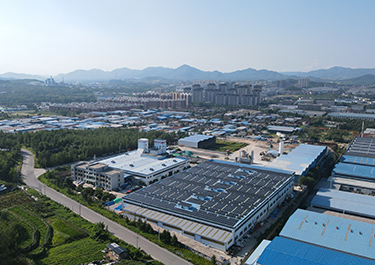 Our FactoryWe have a team of more than 30 talented geotechnical material R&D experts and a 30,000 square meter advanced modern intelligent manufacturing plant.
- Products
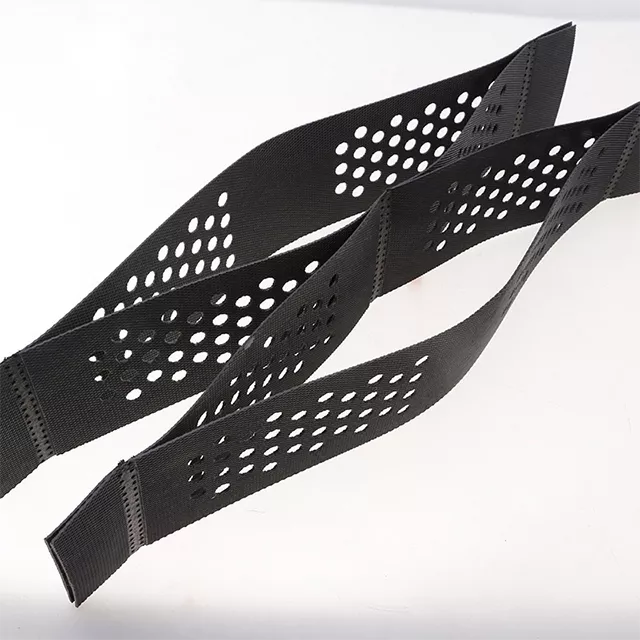 Geocell is a three-dimensional mesh structure made of high-strength polymer sheets (such as HDPE, PP, etc.) through ultrasonic welding. When unfolded, it presents a three-dimensional grid shape.
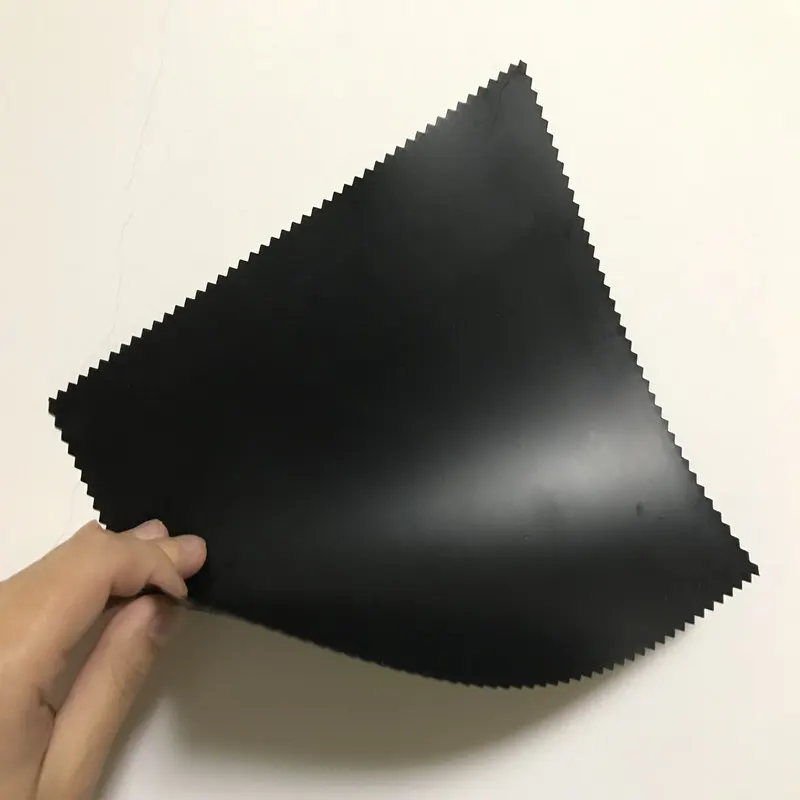 Geomembrane is a thin, extremely low-permeability sheet material made from high-molecular-weight polymers (high-density polyethylene, linear low-density polyethylene).
- Blog
- Contacts
Top 7 Road Construction Geotextile Solutions for Anti-Crack


Cracking is the most visible—and most expensive—form of road deterioration. Reflective cracks propagate upward from an existing pavement layer into a new overlay. Fatigue cracks develop under repeated traffic loading. Settlement cracks appear where subgrade support is inconsistent. In each case, the root cause is the same: stress concentrations that the pavement structure cannot absorb.
A properly specified road construction geotextile addresses this challenge at its source. By providing isolation, reinforcement, and anti-crack functions, geotextiles extend pavement service life, reduce maintenance frequency, and lower lifecycle costs. Field studies consistently show that geotextile-reinforced pavements achieve 2 to 3 times the service life of unreinforced sections—with some projects reporting reduced pavement thickness requirements of 20–40%.
This guide provides the top 7 road construction geotextile solutions for anti-crack performance—backed by ASTM standards, AASHTO design methods, and documented field performance data.
Solution 1: Understand the Three Core Functions – Isolation, Reinforcement, Anti-Crack
Before selecting a road construction geotextile, it is essential to understand the three distinct—but interconnected—functions that a geotextile performs in a pavement system.
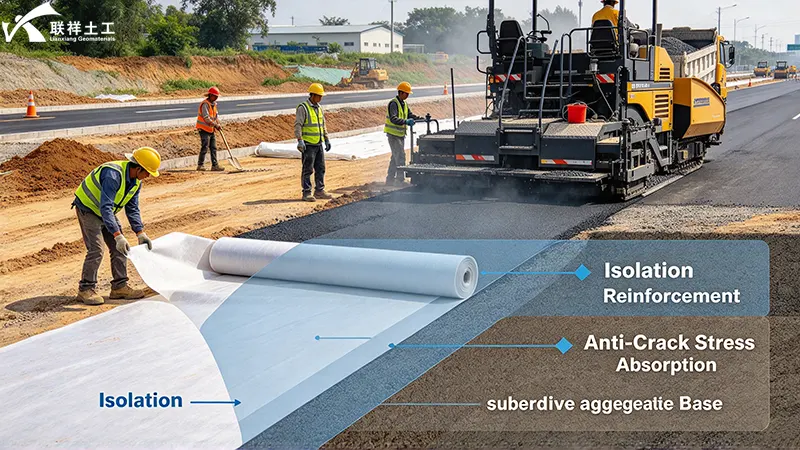
Isolation (Separation): A geotextile placed between the subgrade and the aggregate base course prevents fine soil particles from migrating into the aggregate layer. Without isolation, aggregate punches into the subgrade under traffic loading, and fine particles pump upward into the base—both mechanisms reduce structural capacity and accelerate cracking.
Reinforcement: A high-strength geotextile provides tensile resistance that the soil cannot mobilize on its own. By distributing loads over a wider area and restraining lateral spreading of the aggregate base, the geotextile reduces vertical stress on the subgrade and limits differential settlement—a primary driver of crack formation.
Anti-Crack (Stress Absorption): In overlay applications, a geotextile acts as a stress-absorbing interlayer that retards the propagation of reflective cracks from an existing pavement into a new surface layer. The fabric dissipates stress concentrations at crack tips and prevents water ingress—slowing crack growth and extending overlay life.
| Function | Mechanism | Primary Crack Type Addressed |
|---|---|---|
| Isolation | Prevents aggregate-subgrade intermixing | Settlement cracks, pumping-induced cracking |
| Reinforcement | Tensile load distribution, lateral restraint | Fatigue cracks, rutting-associated cracking |
| Anti-Crack | Stress absorption at crack tips, waterproofing | Reflective cracks, thermal cracks |
Key takeaway: A single road construction geotextile can serve multiple functions depending on where it is placed in the pavement structure. The right choice depends on which cracking mechanism poses the greatest risk to your project.
Solution 2: Select the Right Geotextile Type – Woven vs Nonwoven for Road Base
The choice between a woven geotextile and a nonwoven geotextile is the most important material selection decision for road construction applications.
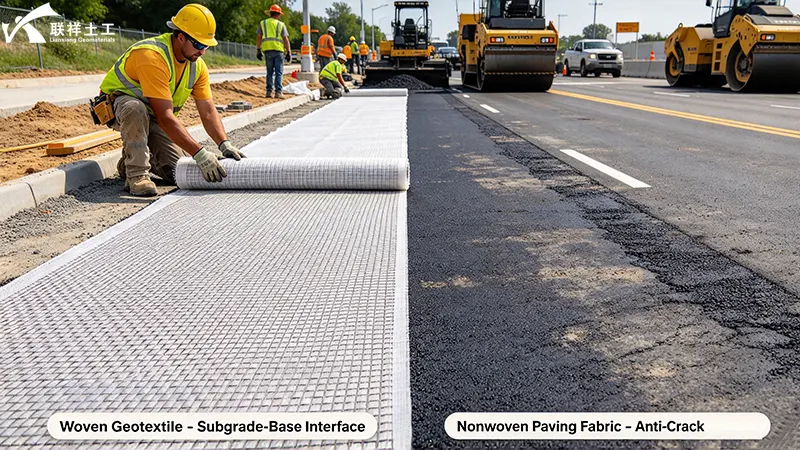
Woven geotextile is manufactured by weaving yarns together on a loom, creating a regular grid structure with high tensile strength and low elongation. For road base reinforcement and isolation, a woven geotextile is generally the preferred choice because its high modulus mobilizes tensile resistance at low strain—exactly what is needed to restrain aggregate lateral spreading under traffic loading.
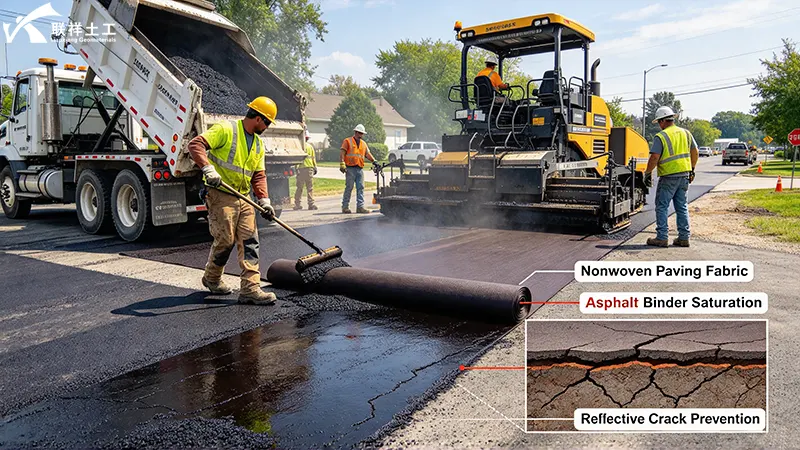
Nonwoven geotextile is manufactured by bonding synthetic fibers together through needle-punching, thermal bonding, or chemical adhesion. For anti-crack overlay systems, a nonwoven geotextile (often a paving fabric) is preferred because its high elongation and stress-absorbing fiber structure dissipate crack-tip stresses and provide a waterproofing membrane when saturated with asphalt binder.
| Property | Woven Geotextile | Nonwoven Geotextile |
|---|---|---|
| Structure | Regular grid | Random fiber network |
| Tensile strength | High | Moderate |
| Elongation | Low (10–25%) | High (50–80%) |
| Primary road function | Isolation, reinforcement | Anti-crack overlay, drainage |
| Best placement | Subgrade-base interface | Pavement overlay interlayer |
Selection guideline:
- Subgrade-base isolation and reinforcement → Specify a woven geotextile with high tensile strength (typically ≥50 kN/m) and low elongation
- Reflective crack prevention in overlays → Specify a nonwoven paving fabric (typically 100–200 g/m²) saturated with asphalt emulsion or binder
- Combined isolation and drainage → Specify a nonwoven geotextile with adequate permittivity
Solution 3: Design the Isolation Layer – Preventing Aggregate Intermixing
The isolation function of a road construction geotextile is fundamental to pavement performance. When aggregate base course intermixes with a soft subgrade, the structural layer loses thickness and stiffness—both of which accelerate cracking.
The isolation mechanism: A geotextile placed at the subgrade-base interface acts as a physical barrier that prevents fine soil particles from migrating upward while allowing water to drain. The geotextile also provides a tensioned working platform that improves compaction efficiency of the aggregate layer.
Design requirements for isolation:
| Parameter | Requirement | Test Method |
|---|---|---|
| Apparent Opening Size (AOS) | 0.20–0.60 mm (depending on soil gradation) | ASTM D4751 |
| Permittivity | ≥0.5 s-1 | ASTM D4491 |
| Tensile strength | ≥50 kN/m (woven) for heavy traffic | ASTM D4595 |
| CBR puncture resistance | ≥2.0 kN | ASTM D6241 |
| Overlap | ≥300 mm | — |
Performance data: Studies on unpaved and paved road sections have demonstrated that a woven geotextile isolation layer can increase the allowable load-carrying capacity of a given aggregate thickness by 30–50%—or allow a reduction in aggregate thickness of 20–40% for the same performance requirement.
Construction tip: Ensure the subgrade is compacted and proof-rolled before geotextile placement. Remove all sharp objects from the upper 150 mm of subgrade. Overlap adjacent geotextile panels by at least 300 mm in the direction of construction traffic.
Solution 4: Optimize Reinforcement – Tensile Strength and Load Distribution
Reinforcement is the function that most directly addresses fatigue cracking—the progressive structural deterioration caused by repeated traffic loading. A road construction geotextile used for reinforcement provides tensile resistance that the subgrade cannot mobilize, distributing loads over a wider area and reducing vertical stress.
How reinforcement reduces cracking:
- Lateral restraint: The geotextile restrains lateral spreading of the aggregate base, maintaining aggregate interlock and stiffness
- Tensioned membrane effect: Under wheel loading, the geotextile acts as a tensioned membrane that distributes load over a wider subgrade area
- Differential settlement reduction: By bridging soft spots in the subgrade, the geotextile reduces differential settlement—a primary cause of longitudinal cracking
Design requirements for reinforcement:
| Parameter | Requirement | Test Method |
|---|---|---|
| Tensile strength at 2% strain | ≥20 kN/m (heavy traffic) | ASTM D4595 |
| Ultimate tensile strength | ≥50–200 kN/m (depending on application) | ASTM D4595 |
| Elongation at break | ≤25% (woven) | ASTM D4595 |
| Modulus | High—mobilizes tension at low strain | — |
| Junction strength | ≥90% of ultimate tensile | — |
Performance data: AASHTO and NCHRP studies have documented that geotextile reinforcement can increase pavement service life by 2 to 3 times compared to unreinforced sections. In one field study, geotextile-reinforced sections showed 50% less rutting and 40% less fatigue cracking after 10 years of service.
Construction tip: For reinforcement applications, specify a woven geotextile with high tensile modulus and low elongation. Ensure the geotextile is tensioned during installation—wrinkles or slack reduce reinforcement effectiveness.
Solution 5: Prevent Reflective Cracking – Geotextile Overlay Systems
Reflective cracking is the propagation of cracks from an existing pavement layer into a new overlay. It is the most common form of overlay failure—and geotextile anti-crack systems are among the most effective mitigation measures.
How geotextile overlay systems work:
- Stress absorption: The geotextile interlayer absorbs stress concentrations at crack tips, preventing them from propagating into the new overlay
- Waterproofing: When saturated with asphalt binder, a nonwoven geotextile forms a waterproof membrane that prevents water ingress into the pavement structure
- Load distribution: The geotextile distributes traffic loads over a wider area, reducing stress on the existing cracked pavement
Types of geotextile anti-crack systems:
| System Type | Description | Typical Application |
|---|---|---|
| Paving fabric | Nonwoven geotextile (100–200 g/m²) saturated with asphalt emulsion | Asphalt overlay over cracked asphalt |
| Geotextile-reinforced overlay | Woven geotextile with high tensile strength | Overlay over jointed concrete or severely cracked pavement |
| Composite anti-crack system | Geotextile + geogrid or stress-absorbing membrane | High-stress applications |
Performance data: Field studies on reflective crack prevention report that geotextile interlayers reduce reflective cracking by 50–80% compared to unreinforced overlays. AASHTO PP 69 provides guidance for geotextile-reinforced asphalt overlay design.
Construction tip: For paving fabric installation, ensure the existing pavement is clean and dry. Apply asphalt emulsion at the specified rate (typically 1.0–1.5 kg/m²), lay the fabric with a mechanical spreader, and compact with a pneumatic-tire roller. Overlap adjacent fabric rolls by 75–100 mm.
Solution 6: Ensure Proper Installation – Overlap, Tension, and Seaming
Installation quality determines whether a road construction geotextile delivers its intended isolation, reinforcement, and anti-crack performance. Common installation errors—insufficient overlap, slack tension, and contamination—can reduce performance by 30–50%.
Installation best practices:
| Parameter | Requirement | Why It Matters |
|---|---|---|
| Overlap (isolation/reinforcement) | ≥300 mm | Prevents soil migration at joints |
| Overlap (paving fabric) | 75–100 mm | Ensures continuous stress absorption |
| Tension | Firm, wrinkle-free | Mobilizes tensile reinforcement |
| Subgrade preparation | Compacted, proof-rolled, free of sharp objects | Prevents puncture during installation |
| Traffic control | Minimize equipment traffic on exposed geotextile | Prevents displacement and damage |
| Cover placement | Place aggregate immediately after geotextile | Prevents UV degradation and wind uplift |
Common installation mistakes to avoid:
- Insufficient overlap: A 150 mm overlap instead of 300 mm creates a pathway for soil migration
- Slack installation: Wrinkles and slack reduce the geotextile's ability to mobilize tensile reinforcement
- Contaminated surface: Mud, debris, or standing water between the geotextile and aggregate reduces friction and isolation performance
- Equipment damage: Tracked equipment turning on exposed geotextile can tear or displace the fabric
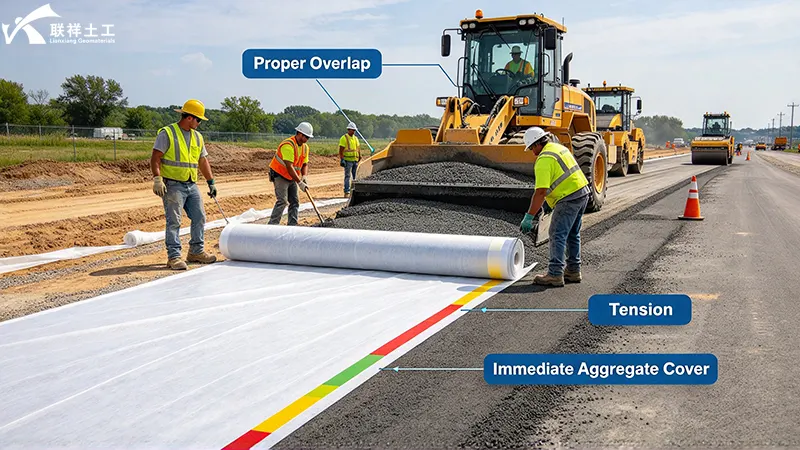
Construction tip: Use a mechanical geotextile spreader for large-area installations to ensure consistent tension and overlap. For small projects, manually tension the geotextile and secure with sandbags or pins before placing aggregate.
Solution 7: Verify Performance – Test Methods and Quality Control
The final—and most often overlooked—solution is verification. A road construction geotextile that meets specification on paper may not meet performance requirements in the field. Quality control testing closes this gap.
Required test methods for road construction geotextiles:
| Property | Test Method | Typical Requirement |
|---|---|---|
| Tensile strength | ASTM D4595 | ≥50 kN/m (woven) |
| Elongation at break | ASTM D4595 | ≤25% (woven) |
| CBR puncture resistance | ASTM D6241 | ≥2.0 kN |
| Trapezoidal tear resistance | ASTM D4533 | ≥0.5 kN |
| Apparent Opening Size (AOS) | ASTM D4751 | 0.20–0.60 mm |
| Permittivity | ASTM D4491 | ≥0.5 s-1 |
| UV resistance | ASTM D4355 | ≥50% strength retention after 500 hrs |
Quality control checklist:
- Request MARV (Minimum Average Roll Values) test reports for the specific production lot—not generic catalog values
- Verify that the geotextile delivered to site matches the specified product (check roll labels and certificates)
- Inspect rolls for damage before installation—reject any rolls with tears, punctures, or UV degradation
- Document installation overlap, tension, and coverage with photographs
- For critical projects, conduct post-installation electrical leak location (ELL) surveys on geomembrane components or visual inspections of geotextile coverage
Construction tip: For highway and airport projects, require the geotextile manufacturer to provide AASHTO M 288 compliance certification. This standard specifies geotextile requirements for separation, stabilization, and drainage applications in transportation infrastructure.
Quick Reference: Top 7 Road Construction Geotextile Solutions
| # | Solution | Key Parameter | Target Crack Type |
|---|---|---|---|
| 1 | Understand three core functions | Isolation, reinforcement, anti-crack | All crack types |
| 2 | Select correct geotextile type | Woven for base; nonwoven for overlay | Depends on placement |
| 3 | Design isolation layer | AOS 0.20–0.60 mm; ≥300 mm overlap | Settlement cracks |
| 4 | Optimize reinforcement | ≥50 kN/m tensile; low elongation | Fatigue cracks |
| 5 | Prevent reflective cracking | Nonwoven paving fabric + asphalt | Reflective cracks |
| 6 | Ensure proper installation | Tension, overlap, immediate cover | All crack types |
| 7 | Verify performance | ASTM D4595, D6241, D4751; MARV reports | Quality assurance |
Final Thoughts
Road construction geotextiles are not a commodity add-on—they are a performance-critical component of any pavement system. Whether the goal is isolation to prevent aggregate intermixing, reinforcement to extend fatigue life, or anti-crack protection to delay reflective cracking, the right geotextile solution can deliver 2–3 times the service life of an unreinforced pavement.
Remember these core principles:
- Match the geotextile to the function: Woven for isolation and reinforcement; nonwoven for anti-crack overlays
- Design for the specific crack mechanism: Settlement, fatigue, and reflective cracking each require a different geotextile solution
- Installation quality matters as much as material quality: Proper overlap, tension, and cover placement determine performance
- Verify with data: Request MARV test reports and AASHTO M 288 compliance for transportation projects
- Consider lifecycle cost, not just unit price: A geotextile that extends pavement life by 5 years pays for itself many times over
Whether you are building a new highway, rehabilitating an aging road, or constructing an unpaved haul road, the right road construction geotextile solution can mean the difference between a pavement that performs for decades and one that requires premature repair.
Lianxiang Group supplies high-quality woven and nonwoven geotextiles for road construction, isolation, reinforcement, and anti-crack applications worldwide. Our technical team can help you select the right geotextile based on your pavement structure, traffic loading, and subgrade conditions. Contact us for free samples, MARV test reports, or a customized solution.
Written by
SHANDONG LIANXIANG ENGINEERING MATERIALS CO., LTD.
Kyle Fan
WhatsApp:+86 139 5480 7766
Email:admin@lianxiangcn.com
-
WhatsApp
-
E-MailE-Mail:admin@lianxiangcn.com
-
WeChatWeChat:18554180188