
- Home
- Company
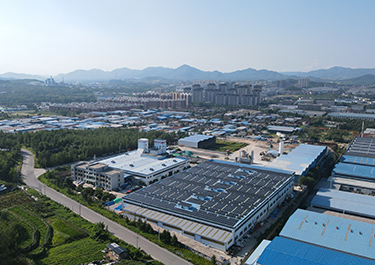 Our FactoryWe have a team of more than 30 talented geotechnical material R&D experts and a 30,000 square meter advanced modern intelligent manufacturing plant.
- Products
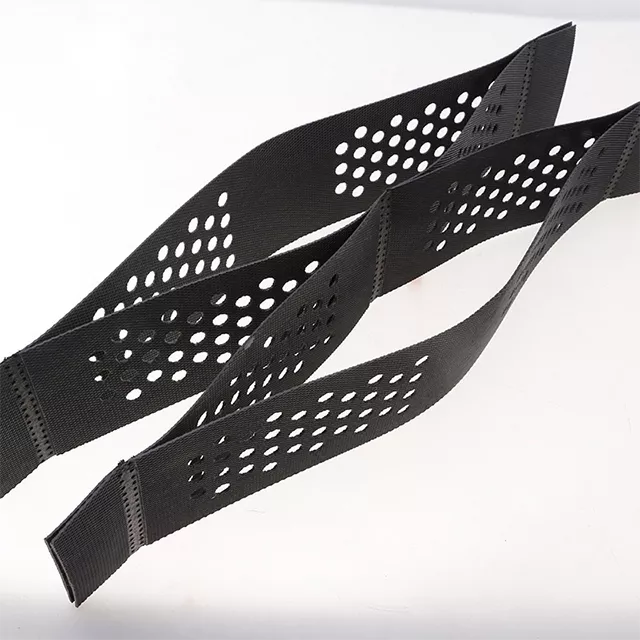 Geocell is a three-dimensional mesh structure made of high-strength polymer sheets (such as HDPE, PP, etc.) through ultrasonic welding. When unfolded, it presents a three-dimensional grid shape.
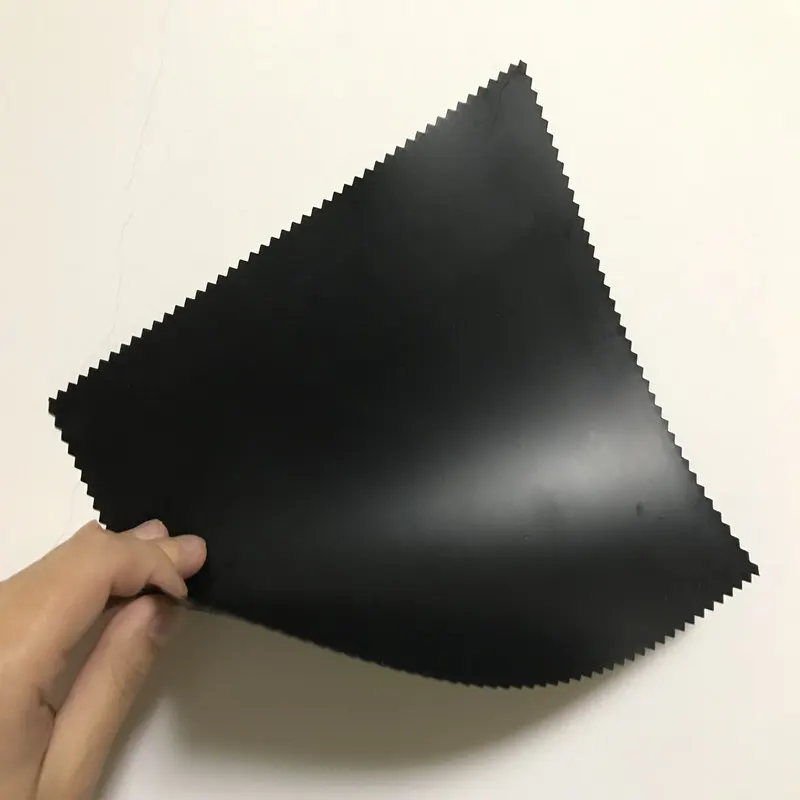 Geomembrane is a thin, extremely low-permeability sheet material made from high-molecular-weight polymers (high-density polyethylene, linear low-density polyethylene).
- Blog
- Contacts
Top 7 Geocell Solutions for Soft Soil Road Stabilization


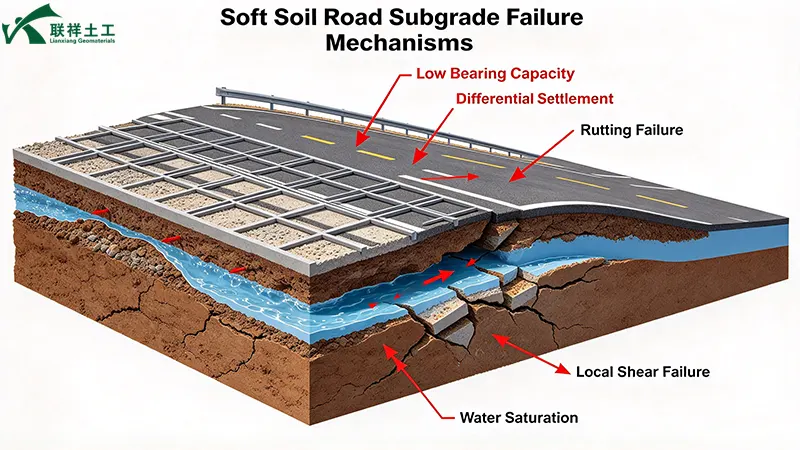
Soft soil is one of the most persistent and expensive challenges in road construction. Subgrades with low bearing capacity—typically clay, silt, peat, or organic deposits with CBR values below 3%—cannot support the loads imposed by pavement structures and traffic. The consequences are predictable: excessive settlement, differential movement, rutting, and premature pavement failure.
Traditional solutions are costly and time-consuming. Excavation and replacement require hauling away poor soil and importing select fill. Deep foundations—piles, stone columns, or cement mixing—demand specialized equipment and significant capital. Geosynthetic reinforcement offers a third path: improving the performance of the existing subgrade rather than replacing it.
Among geosynthetic solutions, the HDPE geocell has emerged as one of the most effective and cost-efficient options for soft soil road stabilization. By confining infill material within a three-dimensional honeycomb structure, the geocell creates a semi-rigid mattress that distributes loads, reduces settlement, and allows the use of locally available fill material.
Field studies consistently demonstrate that geocell-reinforced sections over soft subgrades achieve bearing capacity improvements of 2 to 5 times compared to unreinforced sections—while reducing required aggregate thickness by 30–50%. This guide provides the top 7 geocell solutions for soft soil road stabilization.
Solution 1: Understand the Soft Soil Challenge – Low Bearing Capacity and Differential Settlement
Before selecting a geocell solution, it is essential to understand exactly what makes soft soil problematic for road construction. The issues are interconnected, and a solution that addresses only one will not deliver reliable performance.
Low bearing capacity: Soft soils cannot resist the vertical stresses imposed by pavement layers and traffic loads. Without improvement, the subgrade deforms under load, leading to rutting and structural failure. Typical CBR values for soft soils range from 1% to 3%, compared with 8% to 15% for good granular subgrades.
Differential settlement: Soft soil deposits are rarely uniform. Variations in moisture content, organic content, and consolidation history create zones of differing stiffness. Under load, these zones settle at different rates, producing differential settlement that cracks pavements and disrupts drainage.
Lateral spreading: Under traffic loading, soft subgrade soils tend to displace laterally. This lateral movement reduces support beneath the pavement edge, causing edge cracking and shoulder failure.
Construction traffic damage: Soft subgrades are easily disturbed by construction equipment. Rutting and remolding during construction reduce the already-limited bearing capacity, creating a vicious cycle of worsening conditions.
| Soft Soil Challenge | Mechanism | Consequence |
|---|---|---|
| Low bearing capacity | CBR 1–3%; inadequate shear strength | Rutting, structural failure |
| Differential settlement | Non-uniform soil stiffness | Pavement cracking, drainage disruption |
| Lateral spreading | Horizontal displacement under load | Edge cracking, shoulder failure |
| Construction disturbance | Remolding and rutting by equipment | Further loss of bearing capacity |
Key takeaway: A successful geocell solution must address all four mechanisms simultaneously—not just increase bearing capacity. Load distribution, lateral restraint, and construction platform stability are equally important.
Solution 2: Select the Right Geocell Specification – Height, Cell Size, and Sheet Thickness
The performance of a geocell in soft soil stabilization depends on three primary specification parameters. Getting these right is the foundation of a successful design.
Cell height: For soft soil road stabilization, geocell heights typically range from 100 mm to 200 mm. The height determines the depth of the reinforced layer and the volume of infill material.
| Cell Height | Subgrade CBR | Typical Application |
|---|---|---|
| 75–100 mm | 3–5% | Moderate subgrade improvement, light traffic |
| 100–150 mm | 1–3% | Standard soft soil stabilization, unpaved roads |
| 150–200 mm | <1% | Very soft soil, heavy loads, haul roads |
| 200–300 mm | <1% | Extreme conditions, deep soft deposits |
Welding distance (cell size): For soft soil applications, smaller cells provide better confinement. Common welding distances are 330 mm, 356 mm, and 400 mm. Cells of 330–356 mm are preferred for very soft subgrades and heavy load applications.
Sheet thickness: HDPE sheet thickness determines the tensile strength and durability of the cell walls. For road stabilization over soft soil, a minimum sheet thickness of 1.2 mm is recommended. For heavy-duty applications—mining haul roads, port areas, or extremely soft subgrades—1.5 mm or greater is preferred.
| Parameter | Standard Application | Heavy-Duty Application |
|---|---|---|
| Cell height | 100–150 mm | 150–200 mm |
| Welding distance | 356–400 mm | 330–356 mm |
| Sheet thickness | 1.2 mm | 1.5–1.7 mm |
| Sheet tensile strength | ≥20 MPa | ≥23 MPa |
| Environmental stress crack resistance | ≥500 hours | ≥500 hours |
Construction tip: Always request test reports for sheet tensile strength (ASTM D638), environmental stress crack resistance (ASTM D5397), and weld seam strength. For soft soil projects, the environmental stress crack resistance is especially critical—the geocell must survive long-term loading without brittle failure.
Solution 3: Use Local Soil or Marginal Fill as Infill to Reduce Cost
One of the greatest cost advantages of geocell stabilization over soft soil is the ability to use locally available or marginal fill materials. Unlike geogrid, which requires high-quality angular aggregate for interlock, the geocell confines whatever material is placed within its cells.
Infill options for soft soil road stabilization:
| Infill Type | Suitability | Cost Impact |
|---|---|---|
| Local sandy soil | Good—adequate friction and confinement | Lowest cost |
| Local silty/clayey soil | Acceptable with proper compaction and drainage | Low cost |
| Crushed stone (imported) | Excellent—highest performance | Higher cost |
| Recycled concrete / demolition waste | Good—sustainable and cost-effective | Low to moderate |
| Quarry by-products | Variable—requires testing | Low to moderate |
Infill selection guidance for soft soil:
- Use local sandy or gravelly soil where available—it provides the best balance of confinement, drainage, and cost.
- Clayey soils can be used if compacted to at least 95% Proctor density and protected from moisture ingress. Avoid highly plastic clays that swell and shrink significantly.
- Avoid organic soils, peat, and topsoil as infill—these materials have low strength and high compressibility.
- For the top 100 mm of the geocell layer, consider using higher-quality material (crushed stone or gravel) to provide a stable working platform for subsequent pavement layers.
Cost comparison: On a typical soft soil road project, importing select granular fill can cost 3 to 5 times more than using local soil. The geocell system allows savings of 20–40% on fill material costs while achieving comparable or better performance.
Solution 4: Design the Foundation Layer for Load Distribution and Bearing Capacity
The geocell layer does not act alone—it must be integrated into a foundation design that accounts for the soft subgrade conditions, traffic loading, and required performance.
Design approach for geocell-reinforced soft soil foundations:
| Design Element | Consideration | Typical Value |
|---|---|---|
| Geocell layer thickness | Based on CBR and load | 100–200 mm |
| Separation geotextile | Prevents subgrade contamination | Nonwoven, 200–300 g/m² |
| Infill compaction | Ensures composite behavior | ≥95% Proctor density |
| Base course above geocell | Distributes traffic loads | 150–300 mm granular |
| Surface course | Depends on traffic type | Asphalt or gravel |
Bearing capacity improvement: The geocell-reinforced layer improves the effective bearing capacity of the soft subgrade through several mechanisms:
- Confinement increases the shear strength of the infill material by a factor of 2–5
- Load spreading reduces the stress transmitted to the soft subgrade
- Lateral restraint prevents subgrade soil from displacing sideways
- The semi-rigid mattress bridges local weak spots, reducing differential settlement
Performance data: Plate load tests on geocell-reinforced soft soil sections have demonstrated improvements in the modulus of subgrade reaction (k) of 2 to 4 times compared with unreinforced sections. In one documented project, a geocell layer of 150 mm over a CBR 2% subgrade allowed a reduction in granular base thickness from 600 mm to 350 mm while maintaining equivalent performance.
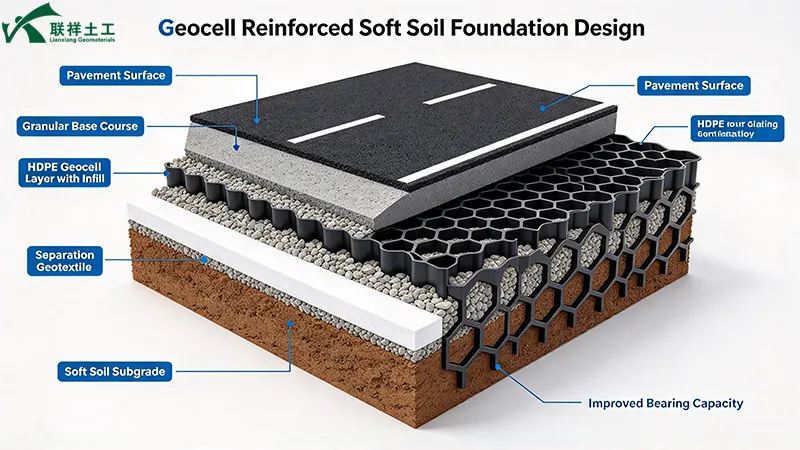
Construction tip: Always install a separation geotextile between the soft subgrade and the geocell layer. This prevents fine subgrade particles from pumping into the geocell infill, which would reduce drainage and confinement effectiveness.
Solution 5: Follow Proper Installation – Subgrade Prep, Expand, Anchor, Fill, Compact
Installation quality is the single largest determinant of geocell performance in soft soil applications. A poorly installed geocell—even with correct specifications—will not deliver the intended bearing capacity improvement.
Installation sequence for soft soil stabilization:
| Step | Action | Key Detail |
|---|---|---|
| 1 | Prepare the subgrade | Clear debris, proof-roll, and level soft spots |
| 2 | Install separation geotextile | Overlap ≥300 mm; secure against wind |
| 3 | Position and expand geocell | Expand panels evenly; avoid over-stretching |
| 4 | Connect adjacent panels | Use clips or keys; maintain continuous coverage |
| 5 | Anchor the perimeter | Steel pins at 1–2 m spacing around edges |
| 6 | Fill cells | Place infill from one side; avoid displacing geocell |
| 7 | Compact infill | Plate compactor or light roller; 95% Proctor |
| 8 | Place base course | Granular layer above geocell; compact normally |
Critical installation rules for soft soil:
- Do not attempt to compact or proof-roll extremely soft subgrade with heavy equipment before geocell installation—this can worsen rutting. Use light equipment or a geotextile working platform.
- For very soft conditions (CBR below 1%), consider a two-layer geocell system or a geocell-geogrid composite.
- Fill the geocell cells completely and compact in a single lift where possible—multiple thin lifts are less effective in confinement applications.
- Avoid driving tracked equipment directly on unfilled geocell—it will damage the cell walls and displace the panels.
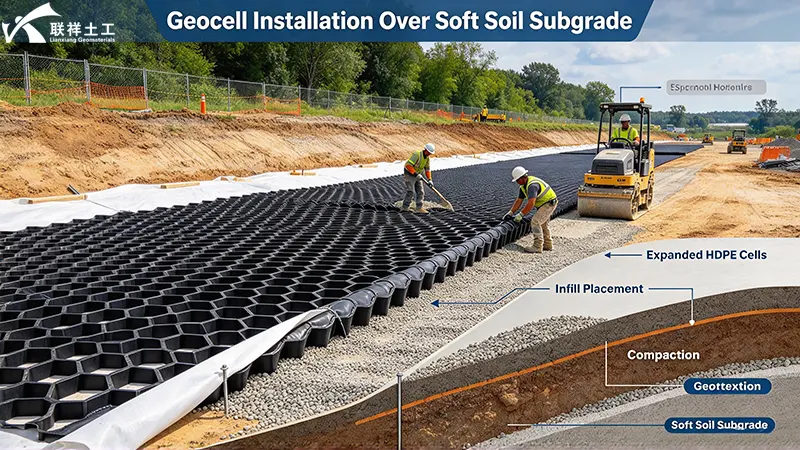
Construction tip: For haul roads and temporary access roads over soft soil, the geocell layer can be installed and used immediately after compaction—no curing time is required. This is a significant advantage over cement-based stabilization methods.
Solution 6: Quantify the Cost Savings – Reduced Aggregate, Less Excavation, Faster Construction
The economic case for geocell soft soil stabilization is compelling—but it requires looking beyond the unit price of the geocell itself to the total installed cost.
Cost comparison: Geocell vs traditional methods:
| Cost Factor | Excavation & Replacement | Deep Foundations | Geocell Stabilization |
|---|---|---|---|
| Excavation | High | Low | Minimal |
| Fill import | Very high | Low | Low (local fill) |
| Disposal of poor soil | High | Minimal | None |
| Specialized equipment | Moderate | Very high | Low |
| Construction time | Long | Very long | Short |
| Traffic disruption | High | High | Low |
| Total installed cost | High | Highest | Lowest |
Documented savings from geocell projects:
- Aggregate reduction: Geocell reinforcement typically reduces required granular base thickness by 30–50%, directly cutting material and hauling costs.
- Fill material savings: Using local soil instead of imported select fill can reduce fill costs by 20–40%.
- Construction time: Geocell installation is fast—a crew can install several hundred square meters per day. No curing time is required, unlike cement stabilization.
- Maintenance reduction: By reducing differential settlement and rutting, geocell-stabilized roads require less frequent repair and resurfacing.
Lifecycle perspective: While the initial cost of a geocell system may be slightly higher than a minimal aggregate layer, the lifecycle cost is significantly lower. A road that fails in 3 years due to inadequate subgrade support costs far more in repairs, traffic disruption, and lost productivity than one that performs for 15–20 years.
Solution 7: Verify Performance – Plate Load Tests, Monitoring, and Quality Control
The final solution is verification. A geocell system that meets specification on paper must be verified in the field to confirm that it delivers the intended bearing capacity improvement.
Verification methods for geocell soft soil stabilization:
| Verification Method | What It Measures | When to Use |
|---|---|---|
| Plate load test | In-situ bearing capacity and modulus | Before and after geocell installation |
| Dynamic cone penetrometer (DCP) | Subgrade strength profile | Quick verification of subgrade conditions |
| Settlement monitoring | Post-construction settlement | Critical structures and high fills |
| Compaction testing | Infill density | During installation (every 500 m²) |
| Visual inspection | Cell integrity, coverage, connections | During and after installation |
Quality control checklist:
- Verify geocell specification against the design—check height, welding distance, sheet thickness, and tensile strength certificates.
- Inspect panels for damage before installation—reject any with cracked welds or torn sheets.
- Confirm separation geotextile is installed with proper overlap (≥300 mm).
- Test infill compaction at regular intervals—minimum 95% Proctor density.
- Document installation with photographs, including before/after views and cell coverage.
- For critical projects, conduct plate load tests on the completed geocell layer to confirm the design modulus.
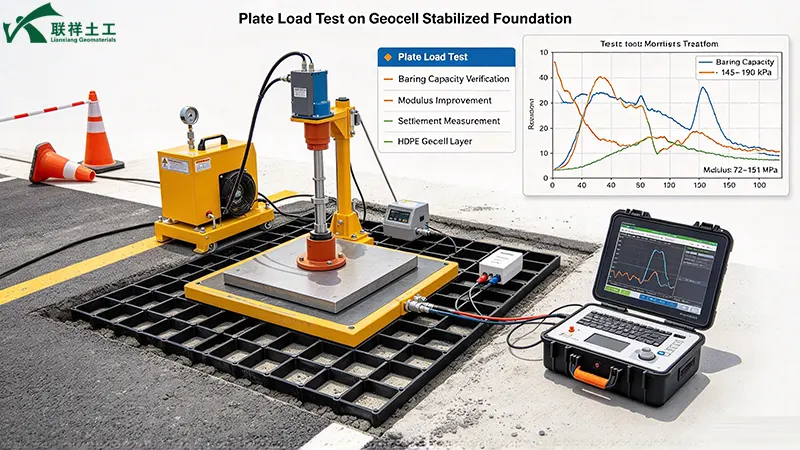
Construction tip: Establish a performance baseline by conducting DCP or plate load tests on the untreated subgrade before geocell installation. This provides the data needed to verify the improvement achieved by the geocell system and to support any design changes during construction.
Quick Reference: Top 7 Geocell Solutions for Soft Soil Road Stabilization
| # | Solution | Key Parameter | Performance Benefit |
|---|---|---|---|
| 1 | Understand soft soil challenge | CBR 1–3%; settlement mechanisms | Informs design requirements |
| 2 | Select correct specification | Height 100–200 mm; thickness ≥1.2 mm | Matches subgrade and load conditions |
| 3 | Use local fill as infill | Local sandy soil preferred | 20–40% fill cost savings |
| 4 | Design foundation layer | Separation geotextile + geocell + base | 2–5× bearing capacity improvement |
| 5 | Follow proper installation | Prep, expand, anchor, fill, compact | Ensures composite behavior |
| 6 | Quantify cost savings | 30–50% aggregate reduction | Lower total installed cost |
| 7 | Verify performance | Plate load test; DCP; compaction | Confirms design assumptions |
Frequently Asked Questions
What is the service life of HDPE geocell under road pavement?
Buried geocell without direct UV exposure can exceed 50 years of service life. If geocell remains exposed above ground, UV stabilizer grades are required to maintain performance beyond 15–20 years.
Can geocell replace deep cement mixing on soft clay?
Geocell cannot fully replace deep soil mixing for extremely thick soft clay layers where total settlement is excessive. However, geocell can reduce the required depth and number of deep treatment columns, delivering major cost savings in many highway and industrial projects.
How fast can geocell be installed?
Experienced crews can deploy and fill around 1,800–2,600 m2 of geocell per working day, making geocell a fast-track ground improvement alternative compared with slow preloading or deep replacement.
Conclusion
Soft soil road stabilization is one of the highest-value applications for HDPE geocell technology. By confining infill material within a three-dimensional cellular structure, the geocell transforms weak, compressible subgrade into a stable working platform that distributes loads, reduces settlement, and supports pavement construction.
Remember these core principles:
- Match the geocell specification to the subgrade CBR and traffic loading—height, cell size, and sheet thickness all matter.
- Use local or marginal fill wherever possible—the geocell's confinement effect makes it far less dependent on high-quality aggregate than geogrid.
- Always install a separation geotextile between soft subgrade and geocell—preventing contamination is essential for long-term performance.
- Follow the installation sequence carefully—expand, anchor, fill, and compact in the correct order.
- Quantify savings beyond unit price—aggregate reduction, fill savings, construction time, and maintenance all contribute to lifecycle cost advantage.
- Verify performance with field testing—plate load tests and compaction data confirm that the design assumptions are met.
Whether you are building a new access road across a peat bog, upgrading an existing haul road over soft clay, or stabilizing a construction platform on compressible silt, the right geocell solution—properly specified, installed, and verified—can deliver reliable performance at significantly lower cost than traditional deep foundation methods.
Lianxiang Group supplies high-quality HDPE geocells in heights from 50 mm to 300 mm, with welding distances of 330–445 mm and sheet thicknesses from 1.0 mm to 1.7 mm. Our technical team can help you select the right cellular confinement system for your soft soil road stabilization project. Contact us for free samples, technical data sheets, or a customized design.
Written by
SHANDONG LIANXIANG ENGINEERING MATERIALS CO., LTD.
Kyle Fan
WhatsApp:+86 139 5480 7766
Email:admin@lianxiangcn.com
-
WhatsApp
-
E-MailE-Mail:admin@lianxiangcn.com
-
WeChatWeChat:18554180188