
- Home
- Company
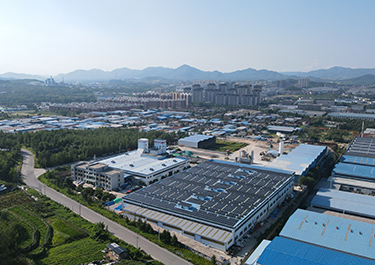 Our FactoryWe have a team of more than 30 talented geotechnical material R&D experts and a 30,000 square meter advanced modern intelligent manufacturing plant.
- Products
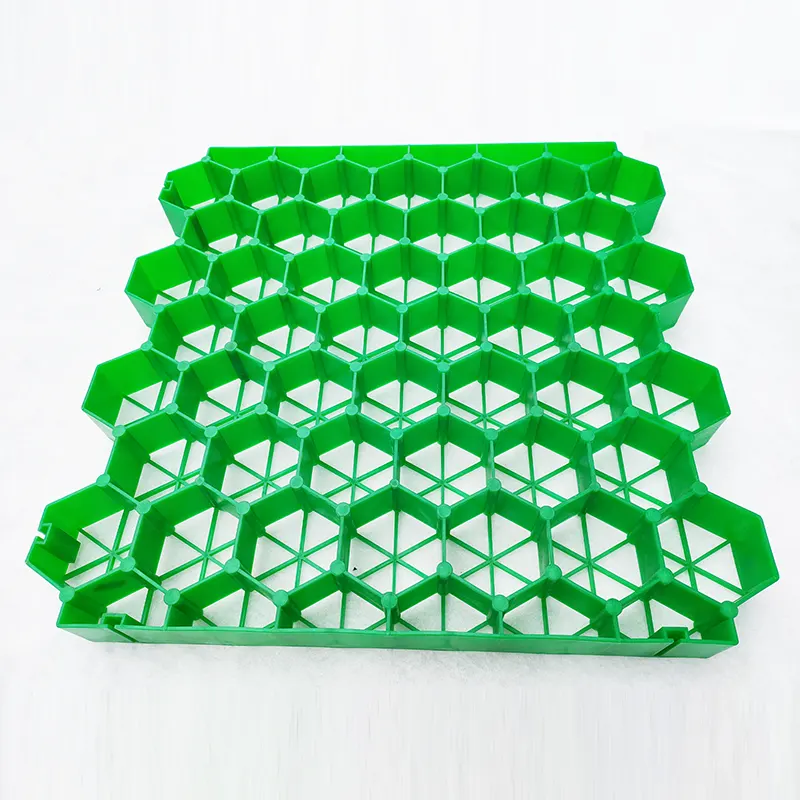
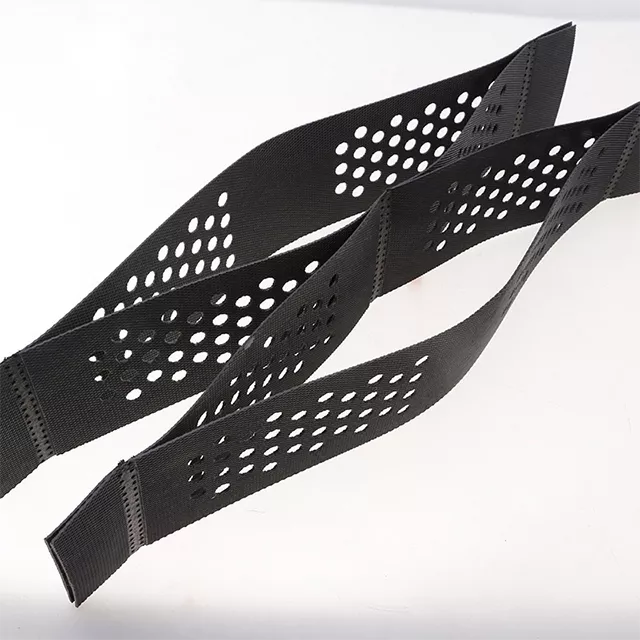 Geocell is a three-dimensional mesh structure made of high-strength polymer sheets (such as HDPE, PP, etc.) through ultrasonic welding. When unfolded, it presents a three-dimensional grid shape.
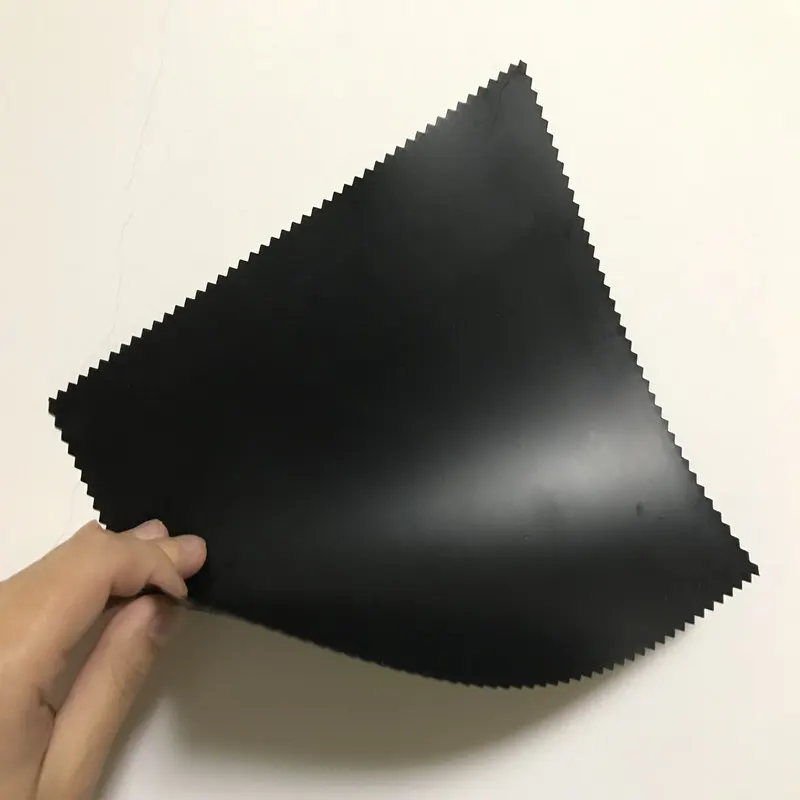 Geomembrane is a thin, extremely low-permeability sheet material made from high-molecular-weight polymers (high-density polyethylene, linear low-density polyethylene).
- Blog
- Contacts
Best Ecological Geocell: 7 Green Slope & River Bank Tips


Concrete retaining walls and riprap armoring solve erosion problems—but at a cost. They sever ecological connectivity, eliminate vegetation, raise surface temperatures, and create a harsh visual landscape. In an era when infrastructure must balance engineering performance with environmental responsibility, the ecological geocell offers a fundamentally different approach.
An ecological geocell is a three-dimensional cellular confinement system manufactured from HDPE—but unlike conventional geocells used solely for mechanical stabilization, the ecological version is designed for vegetation integration. The open cells retain topsoil and moisture, creating a protected root zone where plants can establish even on steep slopes and exposed river banks. Once vegetation matures, the root system binds the infill material and adds cohesive strength, while the canopy intercepts rainfall and reduces flow velocity.
The result is a living engineering structure: the geocell provides immediate mechanical protection, and the vegetation delivers long-term ecological resilience. Field data shows that vegetated geocell slopes can withstand flow velocities of 3–6 m/s—comparable to riprap—while providing habitat, carbon sequestration, and visual amenity that hard armor cannot match.
This guide provides the best ecological geocell practices through 7 green slope and river bank tips—covering design, material selection, vegetation integration, installation, and long-term maintenance.
Tip 1: Understand the Dual Function – Mechanical Confinement and Ecological Restoration
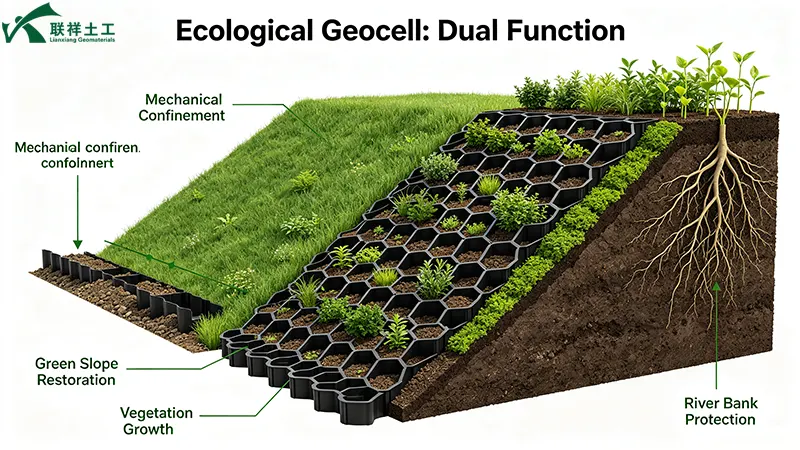
An ecological geocell is not simply a geocell with plants added on top. It is a system designed from the outset to perform two functions simultaneously: mechanical confinement and ecological restoration.
Mechanical confinement: The HDPE cell walls restrain lateral movement of the infill material, increasing shear strength by a factor of 2–5 compared with unconfined soil. On slopes, this confinement prevents surface erosion and shallow sliding. On river banks, it resists hydraulic scour and toe erosion.
Ecological restoration: The open cell structure retains topsoil and moisture, providing a stable root zone for vegetation. Unlike closed surfaces—concrete, shotcrete, or asphalt—the ecological geocell allows water infiltration, air exchange, and root penetration. The result is a self-repairing surface that becomes stronger as vegetation matures.
| Function | Mechanism | Performance Benefit |
|---|---|---|
| Mechanical confinement | Cell walls restrain lateral spreading | 2–5× shear strength increase |
| Erosion resistance | Cells prevent particle detachment | Withstands 3–6 m/s flow velocity |
| Vegetation support | Protected root zone retains soil and moisture | Plant establishment on steep slopes |
| Ecological connectivity | Permeable surface supports habitat | Habitat creation, carbon sequestration |
Key takeaway: The ecological geocell is a living structure. Its performance improves over time as vegetation establishes—unlike hard armor, which degrades slowly from the day it is installed.
Tip 2: Select the Right Ecological Geocell Specification – Height, Cell Size, and Perforation
Ecological geocells differ from standard geocells in several specification details that are critical for vegetation performance.
Cell height: For green slope restoration and river bank protection, cell heights of 75–150 mm are most common. Shallower cells (75–100 mm) are suitable for gentle slopes and areas where vegetation is the primary protection. Deeper cells (100–150 mm) are used on steeper slopes and river banks where mechanical confinement must carry more load.
| Cell Height | Slope Gradient | Application |
|---|---|---|
| 50–75 mm | Gentle slopes (≤1:3) | Landscape restoration, gentle embankments |
| 75–100 mm | Moderate slopes (1:3 to 1:2) | Standard green slope restoration |
| 100–150 mm | Steep slopes (1:2 to 1:1.5) | River banks, high-flow channels |
| 150–200 mm | Very steep slopes (≥1:1.5) | Severe erosion conditions |
Cell size (welding distance): Smaller cells provide better confinement and are preferred for steep slopes. For ecological applications, welding distances of 330–400 mm are typical. The cell size must be large enough to accommodate the root ball of the target vegetation—small cells can restrict root development of larger species.
Perforation: Ecological geocells typically feature perforated cell walls. The perforations serve three purposes: they allow lateral water movement between cells (preventing waterlogging), they facilitate root propagation across cell boundaries (improving vegetation continuity), and they reduce weight and material cost. Specify a perforation rate of 5–10% of the cell wall area.
| Specification | Standard Ecological Geocell | Heavy-Duty River Bank Geocell |
|---|---|---|
| Cell height | 75–100 mm | 100–150 mm |
| Welding distance | 356–400 mm | 330–356 mm |
| Sheet thickness | 1.0–1.2 mm | 1.2–1.5 mm |
| Perforation | Yes (5–10%) | Yes (5–10%) |
| UV stabilization | ≥2% carbon black | ≥2% carbon black |
Construction tip: Always confirm that the geocell is manufactured from virgin HDPE with UV stabilization. Recycled-content geocells may degrade prematurely under sunlight exposure—a critical consideration for exposed slope and river bank applications.
Tip 3: Design the Vegetation Strategy – Native Species and Root Architecture
The vegetation strategy is what distinguishes an ecological geocell from a conventional geocell. Selecting the right plant species—and understanding their root architecture—is essential for long-term performance.
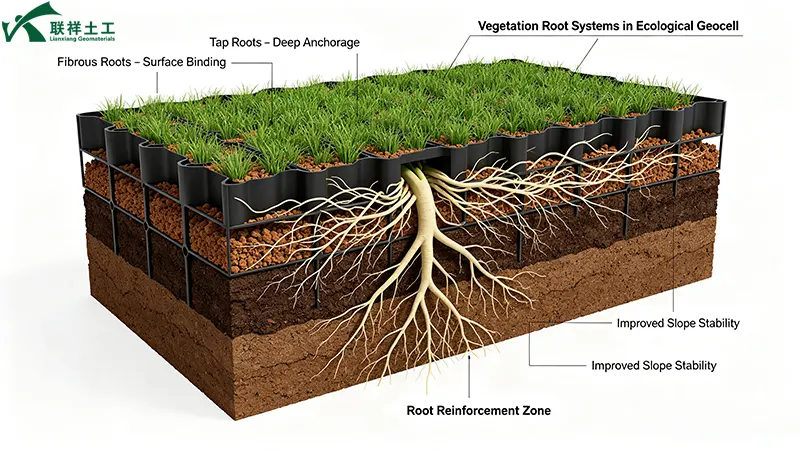
Root architecture matters: Different plant species have different root systems, and these affect how effectively the vegetation reinforces the geocell infill.
| Root Type | Characteristics | Best Application |
|---|---|---|
| Fibrous roots | Dense, shallow, bind surface soil | Surface erosion control, gentle slopes |
| Tap roots | Deep, penetrate subsoil | Slope stability, anchorage |
| Rhizomatous roots | Spread laterally, form networks | River banks, continuous cover |
| Mixed root systems | Combination of above | Most comprehensive protection |
Species selection guidelines:
- Use native species wherever possible—they are adapted to local climate, soil, and hydrology, and require less maintenance.
- Select species with deep root systems for slope stability applications—grasses with fibrous roots alone are insufficient for steep slopes.
- For river banks, choose species tolerant of periodic inundation and variable moisture conditions.
- Avoid invasive species—they can outcompete native vegetation and reduce ecological value.
- Consider a mix of grasses, legumes, and shrubs to provide both surface protection and deeper reinforcement.
Construction tip: For steep slopes where direct seeding is difficult, consider hydroseeding with a tackifier, or use pre-vegetated geocell panels. Apply a temporary erosion control blanket over the seeded surface until vegetation establishes—typically 4–8 weeks.
Tip 4: Design for River Bank Protection – Hydraulic and Scour Considerations
River bank protection presents different challenges from slope restoration. The bank is subject to flowing water, wave action, and fluctuating water levels—all of which impose hydraulic forces that the geocell system must resist.
Hydraulic design considerations:
| Factor | Consideration | Design Response |
|---|---|---|
| Flow velocity | 3–6 m/s during flood events | Use deeper cells and gravel infill |
| Wave action | Boat wakes, wind waves | Increase cell height; add toe protection |
| Water level fluctuation | Drawdown and refill cycles | Select vegetation tolerant of inundation |
| Scour at toe | Concentrated flow at bank toe | Extend geocell below low water level |
| Debris impact | Floating logs, ice | Increase sheet thickness; anchor securely |
River bank design principles:
- Extend the geocell system below the low water level to prevent toe scour and undermining.
- Anchor the top edge in a trench set back from the bank crest—undercutting of the crest is a common failure mode.
- Use gravel or crushed stone infill in the zone subject to wave action and high flow; use topsoil and vegetation above the normal high water line.
- For very high flow velocities (greater than 6 m/s), consider a composite system combining geocell with a geotextile filter and additional toe protection.
- Ensure the geotextile separation layer beneath the geocell extends beyond the geocell footprint to prevent soil migration at the edges.
Performance data: Field studies on vegetated geocell river banks report that established vegetation can reduce near-bank flow velocities by 30–50%, significantly reducing scour potential. The combination of geocell confinement and vegetation is more effective than either alone—the geocell provides immediate protection while vegetation establishes, and the vegetation provides long-term reinforcement.
Tip 5: Follow the Correct Installation Sequence – Prepare, Anchor, Expand, Fill, Plant
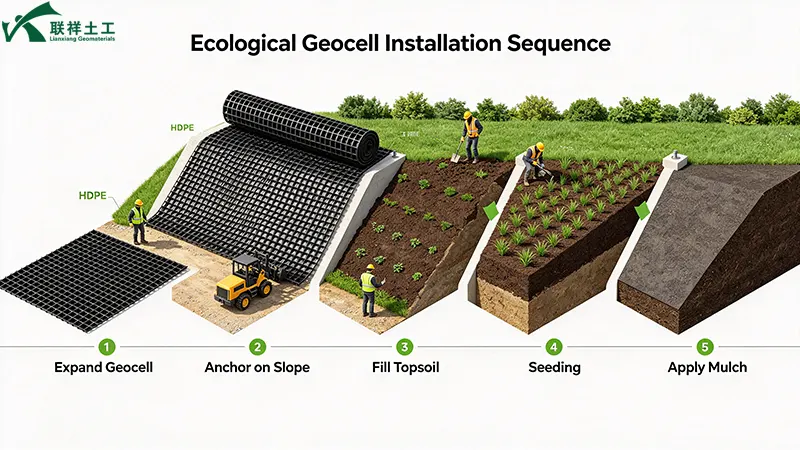
Installation quality determines whether the ecological geocell achieves its intended performance. The sequence is similar to conventional geocell installation—but with additional steps for vegetation integration.
Installation sequence for ecological geocell:
| Step | Action | Key Detail |
|---|---|---|
| 1 | Prepare the slope or bank | Clear vegetation and debris; grade to uniform profile |
| 2 | Install separation geotextile | Overlap ≥300 mm; secure against wind |
| 3 | Excavate anchor trench | Crest and toe; 300 mm × 300 mm minimum |
| 4 | Position and expand geocell | Work from top down; expand evenly |
| 5 | Anchor the geocell | Anchor trench + steel pins at 1–2 m spacing |
| 6 | Fill the cells | Topsoil for vegetated zones; gravel for hydraulic zones |
| 7 | Compact the infill | Light compaction—do not over-compact topsoil |
| 8 | Seed or plant | Hydroseed, broadcast seed, or plant plugs |
| 9 | Apply mulch or blanket | Protect seedlings until establishment |
Critical installation rules for ecological geocell:
- Do not over-compact topsoil infill—it reduces porosity and inhibits root penetration. Light compaction is sufficient for vegetated zones.
- Ensure the topsoil is free of weeds and contaminants—introducing invasive species undermines the ecological objective.
- Install the geocell as close to the seeding operation as possible—exposed topsoil dries out quickly and reduces germination rates.
- For river bank applications, schedule installation during low-flow periods to minimize construction difficulty and environmental impact.
Construction tip: For large projects, complete installation in sections—prepare, install geocell, fill, and seed one section before moving to the next. This minimizes exposure of bare topsoil and improves vegetation establishment rates.
Tip 6: Implement a Maintenance Plan for Vegetation Establishment and Long-Term Performance
An ecological geocell system requires maintenance during the vegetation establishment phase—typically the first 6 to 12 months—and periodic inspection thereafter. Without proper maintenance, vegetation may fail to establish, and the ecological benefits of the system will not be realized.
Maintenance schedule for ecological geocell:
| Phase | Timeframe | Maintenance Actions |
|---|---|---|
| Establishment | 0–3 months | Irrigate as needed; repair eroded areas; reseed bare patches |
| Early growth | 3–6 months | Fertilize if required; control weeds; inspect for erosion |
| Maturation | 6–12 months | Reduce irrigation; monitor vegetation coverage; repair damaged cells |
| Long-term | Annual | Inspect cell integrity, anchors, vegetation health, and erosion |
Common maintenance issues and solutions:
- Bare patches: Reseed and cover with mulch or erosion control blanket. Identify the cause—herbivory, drought, poor seed-soil contact—and address it.
- Cell damage: Replace damaged panels or sections. Minor cracks can be repaired with HDPE patches and extrusion welding.
- Anchor failure: Re-anchor loose sections with additional steel pins or extend the anchor trench.
- Invasive species: Remove invasive plants promptly before they outcompete native vegetation.
- Erosion at edges: Extend the geocell or add toe protection where scour is observed.
Performance expectation: With proper maintenance, an ecological geocell slope or river bank should achieve full vegetation coverage within 12–18 months. Once established, the system requires minimal maintenance—typically an annual inspection and occasional repair.
Tip 7: Verify Ecological and Engineering Performance – Monitoring and Assessment
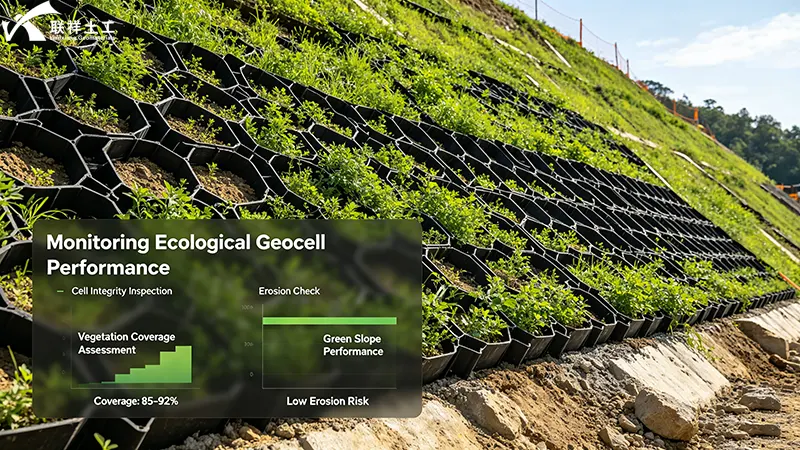
The final tip is verification. An ecological geocell system should be monitored to confirm both engineering performance (stability, erosion control) and ecological performance (vegetation coverage, habitat value).
Monitoring parameters:
| Parameter | Method | Frequency |
|---|---|---|
| Vegetation coverage | Visual assessment or drone imaging | Every 3 months during establishment; annually thereafter |
| Species composition | Quadrant sampling | Annually |
| Cell integrity | Visual inspection | Annually and after flood events |
| Erosion or scour | Survey markers, photographs | Annually and after high-flow events |
| Slope stability | Visual inspection for cracks or movement | Annually |
| Water quality (river bank) | Turbidity, sediment sampling | Seasonally during construction; annually thereafter |
Success criteria for ecological geocell performance:
- Vegetation coverage of at least 80% within 18 months of installation
- No significant erosion or scour on the slope face or river bank
- No deformation or displacement of the geocell structure
- Establishment of native species with deep root systems
- No invasive species dominance
Construction tip: Establish a baseline monitoring record at the time of installation. Photograph the slope or bank from fixed reference points, record vegetation species and coverage, and document the condition of the geocell structure. This baseline is invaluable for assessing long-term performance and identifying changes.
Quick Reference: Best Ecological Geocell – 7 Green Slope & River Bank Tips
| # | Tip | Key Parameter | Target Outcome |
|---|---|---|---|
| 1 | Understand dual function | Confinement + ecological restoration | Living engineering structure |
| 2 | Select correct specification | Height 75–150 mm; perforated; virgin HDPE | Vegetation-compatible system |
| 3 | Design vegetation strategy | Native species; deep root systems | Long-term ecological resilience |
| 4 | Design for river bank protection | Scour protection; toe extension | Hydraulic stability |
| 5 | Follow installation sequence | Prepare, anchor, expand, fill, plant | Proper system formation |
| 6 | Implement maintenance plan | Irrigation, weed control, repair | Successful vegetation establishment |
| 7 | Verify performance | Vegetation coverage ≥80%; erosion check | Confirms design objectives |
Final Thoughts
The best ecological geocell is not simply a geocell with plants on top—it is a system engineered for the integration of mechanical confinement and ecological restoration. On green slopes and river banks, this dual-function approach delivers benefits that neither hard armor nor vegetation alone can achieve: immediate erosion protection, long-term stability, habitat creation, and visual improvement.
Remember these core principles:
- Design for both functions from the outset—mechanical confinement and vegetation integration must be considered together, not sequentially.
- Select the right specification—cell height, welding distance, perforation, and virgin HDPE material are all critical for ecological performance.
- Choose native species with deep root systems—vegetation is not an afterthought; it is a structural component of the system.
- Adapt the design to the hydraulic conditions—river banks require different detailing than slopes, particularly for toe scour and wave action.
- Install correctly and maintain during establishment—the first 12 months determine whether the vegetation will succeed.
- Monitor and verify—both engineering and ecological performance should be assessed to confirm that the system is delivering its intended benefits.
Whether you are restoring a degraded slope, stabilizing a river bank, or integrating green infrastructure into a civil engineering project, the right ecological geocell system—properly specified, installed, and maintained—can deliver decades of reliable protection while restoring ecological function and visual amenity.
Lianxiang Group supplies high-quality ecological geocells in heights from 50 mm to 200 mm, with perforated cell walls, UV-stabilized virgin HDPE, and welding distances of 330–445 mm. Our technical team can help you select the right cellular confinement system for your green slope restoration and river bank protection project. Contact us for free samples, technical data sheets, or a customized design.
Written by
SHANDONG LIANXIANG ENGINEERING MATERIALS CO., LTD.
Kyle Fan
WhatsApp:+86 139 5480 7766
Email:admin@lianxiangcn.com
-
WhatsApp
-
E-MailE-Mail:admin@lianxiangcn.com
-
WeChatWeChat:18554180188